The Story of Shannon
A Pioneer Mixed-Breed in a Purebred Competition World
This article was originally published in the June 2026 OVERview digital magazine.
We all know dogs that have stayed with us over time, and no matter how many follow in their paw prints, they remain etched in our hearts. For Hall of Famer Stuart Mah of Chino, California, that dog was Shannon.
The Story of Shannon
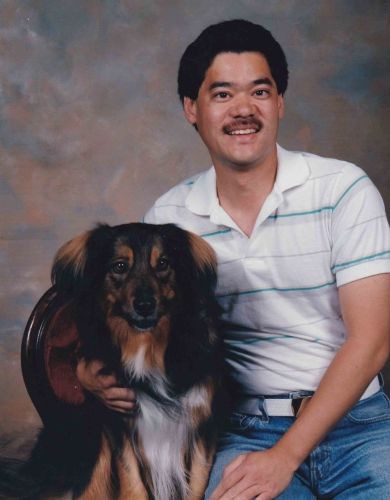 I was living in a Chino townhouse complex and had just gotten TJ, an Australian Shepherd. One day a little brown dog showed up on the street in front of the townhouse. She was pretty skittish and would run if you approached her. People kept trying to catch her, so it made sense that she was a little fearful of people. As near as I can figure, she was about 6 to 9 months old. Over the next several weeks I would see her occasionally around the complex, and she had no collar or tags. We had an earthquake about the time she showed up, and people assumed she had gotten scared and run away.
Over the next weeks, she gradually moved closer to the house. It took some time getting her into the garage by putting out a trail of dog biscuits for her to follow. In actuality, it took about five minutes of slowly laying a continual trail of treats to the point where she was in the garage and I was able to touch her at all. During the time we were working on our relationship, I decided to call her Shannon and decided to keep her. She was pretty nervous, especially with TJ around, but she seemed to trust me enough; if I went from one room to another she would get up and follow.
Over the next several months, I focused on getting her checked out and helping her adjust to living indoors. Someone at the vet’s office suggested obedience training to build her confidence, so I enrolled her in a class. She was very smart and learned quickly. Through those classes, I discovered that dogs could earn obedience titles. Because she was a mixed breed, she could not compete in AKC shows. However, I learned about an organization called AMBOR that awarded titles to mixed-breed dogs at practice matches hosted by recognized obedience clubs.
How We Got Into Agility
It was at one of these practice matches in 1989 that I learned about a new dog sport called agility. West Valley Dog Sports (WVDS) in Southern California was doing an agility demonstration and offered to let dogs try out the equipment with the assistance of coaching by a member of the group. I was extremely fortunate to get Kathy Lofthouse as our coach. Although not scared, Shannon was a little concerned at first but quickly shed any apprehension and took to the obstacles. Kathy really encouraged me to follow up.
Our First Competition
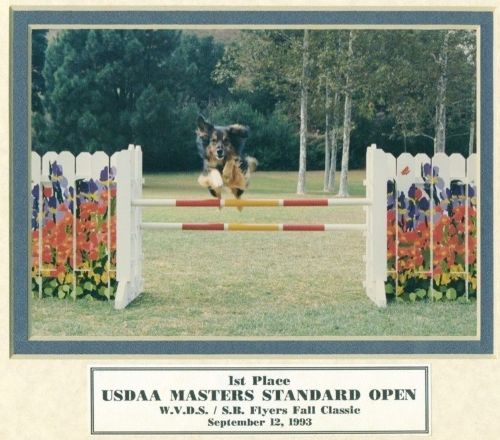
In April of 1990, I learned about USDAA, which was holding a sanctioned agility event in Southern California. At the time, USDAA was just getting started, so Ken Tatsch was there promoting the Grand Prix of Dog Agility® tournament regional competition and supporting the National Finals being held at the AKC Houston Astro Dog Show. It was there that I learned how to play snooker for the first time, and surprisingly we ended up second in Grand Prix, qualifying for the National Finals with a dog that had a little over five months of training.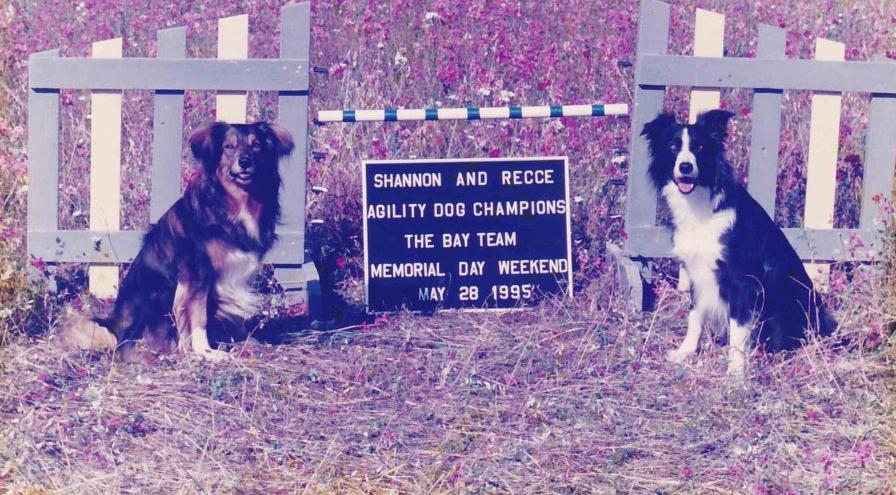
On to Grand Prix Finals
I considered not going because the event was being held in Houston, requiring a two- or three-day drive or a plane flight. I couldn’t take that much time off work for a long drive, and with Shannon initially being a skittish about new things, I knew a plane flight would probably be pretty upsetting. Fortunately, I had a solution. I have a private pilot license. So, every couple of weeks from April to about June, I rented a plane, put a crate in the back seat and took Shannon for a ride. She got used to flying enough that when we finally got on the plane for Houston, she could cope with the flight.
Our first National Finals (and our third show ever) went well. We made finals and placed sixth overall. While we were there, we met a lot of great people, all of whom were friendly and supportive, although most if not all the dogs were purebred because Astrohall (held on the grounds of Houston Astrodome) was an AKC event. It was considered a “demonstration” event so it wasn’t sanctioned as an AKC event. I don’t know the particulars of what Ken and the AKC agreed to but I imagine that Ken said that any dog that wanted to come and compete should be able to, even mixed breeds. We were even asked to appear on The David Letterman television show to do a demo.
A Mixed Breed at FCI
1991 turned out to be a good year for Shannon and me. In April, Ken was at the regional again. He was taking a team to compete in agility at the Fédération Cynologique Internationale (FCI) World Dog Show in Dortmund, Germany, and he wanted Shannon to go.
 The show was fantastic, and the Germans were extremely enthusiastic about the Americans being there. No one seemed to mind that a mixed breed was there. As far as I know, she has been the only mixed breed to compete in FCI. The hardest part about the event was that FCI was only doing large dog agility at 30 inches. Since Shannon was competing at 24 inches in the U.S. I had to train her to jump six inches higher than she was used to. The team placed third overall.
Shannon went on to win the Grand Prix finals that year as well as the Dog Agility Masters® (DAM) tournament with Felicia Whalen and Dash, Sharon Nelson and Mike, two of her U.S. teammates. She went one more time to compete overseas and eventually earned her ADCH along with my other dog, Recce, at Bay Team in Northern California.
Before Shannon retired, she ended up with two more placements in the Grand Prix Nationals. (They didn’t have performance heights at the time so many people retired their dogs earlier than they do now.) Since Shannon, I have had several more dogs (Recce, Leia, Qwik, Alley Jet and Ares) that have done extremely well in both national and international competitions (multiple first place or gold medal finishes).
However, being the first, Shannon will will always have a special place in my heart and soul. When I think of where we came from, from her being scared and shy, to her being at the pinnacle of agility is, to me, remarkable. Nowadays most people breed dogs specifically for agility from selected lines or crosses, so that fact that she was a stray rescue that reached the top is even more amazing. I guess that shows that with time, patience and love, any dog can reach for the highest star.
“I think that USDAA has always looked upon agility as a sport for dogs. Not herding, not sporting, not purebred, but all dogs regardless of lineage. At one time, having a mixed-breed dog left us out of a lot of things, like competition, so I am grateful to Ken Tatsch and USDAA for supporting mixed-breed dogs so early in the game. I also credit Ken for putting enough trust in us that he would take a mixed-breed dog to a major event like the World Dog Show. (Ken, I hope we didn’t disappoint.)” — Stuart Mah