Fitness Essentials for Handlers
Stabilizer muscles are key to balance and flexibility.
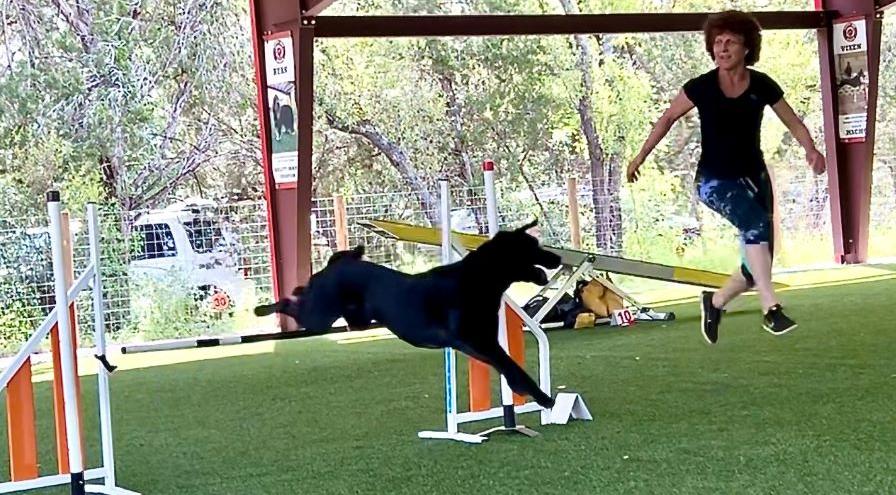
This article was originally published in the February 2025 OVERview digital magazine.
Many handlers focus on their dogs’ fitness for agility, but your fitness is just as important. This article will introduce the novice or “retired” exerciser to the essentials of handler fitness, but it is valuable to the seasoned athlete as well. You may see a similarity between canine and human fitness training!
As a fitness trainer of 25 years, I have worked with athletes in many sports, including equestrians, tennis and racquetball players, golfers, distance runners and more, and now dog agility handlers. I got into the sport of agility only about two years ago. This has provided a great opportunity to understand the movement patterns unique to the sport and how I can help my fellow competitors achieve their goals by working on their health and fitness.
Of course, good nutrition, hydration and rest (which incorporates good timing of training as well as healthy sleep habits) are key components of fitness and should be on the top of everyone’s list. For the purposes of this article, however, I want to introduce you to some very helpful partners in your quest for better handling. They are vital to a good fitness program and a good place to start, especially for novice exercisers. They are your stabilizer muscles.
Understanding the stabilizer muscles
Stabilizer muscles are crucial for optimal movement, injury prevention and long-term physical health. They are not the typical muscles focused on in most weight training programs, but a good base of awareness and development of these muscles will set you up for success as you build overall fitness. Their primary function is to provide support and stability to joints during movement.
Strong stabilizer muscles allow you to:
- Stay healthy: Stabilizer muscles help maintain proper joint alignment and stability during movement, reducing the risk of injury. This is crucial for athletes such as handlers, who are engaging in sports that involve dynamic movements and sudden changes in direction.
- Improve balance and coordination: These muscles play a key role in balance and coordination by providing support and stability to the body during movement. By strengthening these muscles, handlers can improve their balance and coordination and be safer and faster during training and competition.
- Move more freely: Stabilizer muscles are essential for maintaining proper posture, making it easier for handlers to carry out the challenges on a course efficiently and easily.
- Stay sound long-term: These muscles help stabilize the joints, protecting them from excessive stress. This is particularly important for handlers with joint-related issues or previous injuries.
- Be a better athlete: Strong stabilizer muscles contribute to better movement mechanics, agility and power generation in handlers, which can translate to improved athletic performance and reduced risk of sports-related injuries. Targeting stabilizer muscles in training programs can help handlers optimize their performance and excel in their sport.
Strengthening your stabilizer muscles
How do we work on these muscle groups to get stronger and better equipped to run our dogs? Fortunately, there are quite a number of exercises to strengthen core and stabilizer muscles. Since everyone is different, both in fitness levels and injury history, I will give a general list of exercises for the most essential stabilizer muscles; these can be adjusted for any level. Videos of most of these exercises, plus some others, are on my YouTube channel, under Exercises for Everyone.
Please get approval from your physician or rehab specialist before starting an exercise program.
Transverse abdominis
This is your built-in natural weight belt, providing stability to the spine and pelvis. It is the most important muscle to access first. It is the foundation for all other strength and stability work.
Engaging the transverse abdominis involves drawing in your lower abdomen as if zipping up a tight pair of pants. Visualize tucking up your abdomen like a whippet or greyhound. This can be done sitting, standing, lying supine (face up) with knees bent at first, or on hands and knees. Find the position that works best for you and try multiple holds (up to 10 seconds) until you can really connect with that crucial muscle. You can practice in your car or while waiting for your class at a trial! Then try to keep it drawn in while running your course.
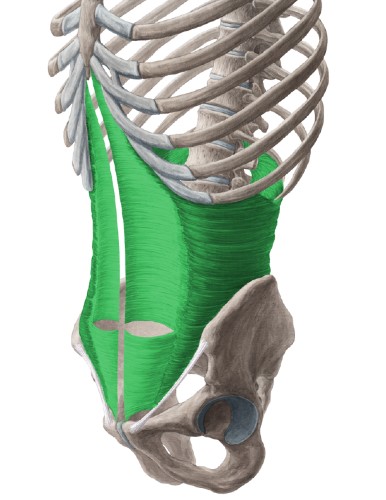
Transversus abdominis muscle
Deep and postural muscles of the back
The deep muscles of the back control spinal stability, in particular the multifidus muscles that run between vertebrae. They respond in split seconds to keep us right side up. (Don’t worry about all the long names!)
A cobra pose works these muscles by activating them while you are lying prone (face down). Squeeze your glutes (buttocks) and raise your upper body, arms and head off the ground. Your arms can be slightly away from your body, shoulders back, arms externally rotated to a thumbs-up position. Hold for a few seconds initially, and work to longer holds of up to 15 seconds. Repeat 5-6 times.
While not strictly stabilizers, the postural muscles of the back are required for good postural alignment. When strengthened, they oppose rounding of the back, anteriorly rotated shoulders and forward head posture.
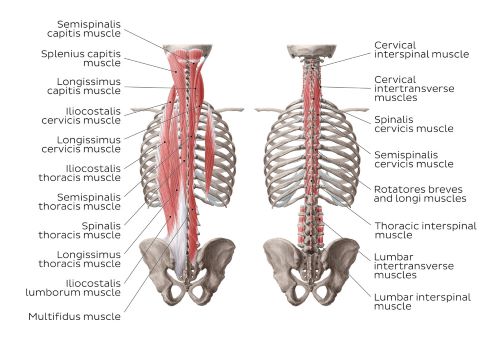
Deep muscles of the back
Obliques and quadratus lumborum
Obliques, internal (shown here) and external, help with spinal rotation and lateral flexion, contributing to core stability and preventing excessive strain on the lower back. Quadratus lumborum, the muscle on either side of the lower back, helps stabilize the pelvis and spine during activities like lifting, bending and twisting.
Obliques and quadratus lumborum can be strengthened with a side plank. Beginners should start on their knees, later progressing to their feet up against a wall. Place your elbow directly under your shoulder and align yourself so shoulder, hip and knees are in a line. Raise up onto forearm and knee or feet. With chest forward, transverses abdominis engaged, raise trunk and hips off the ground. Slowly lower (stay off the ground if possible), repeat. Work up to 10 times. Switch sides. You may notice that one side is stronger. If you have shoulder issues, try putting your opposite hand on the ground or on a block in front of your chest. Do not round forward.
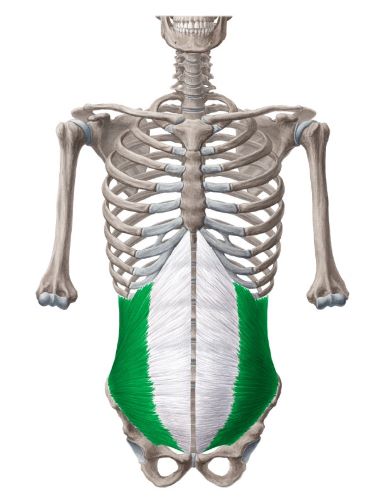
Internal abdominal oblique muscles
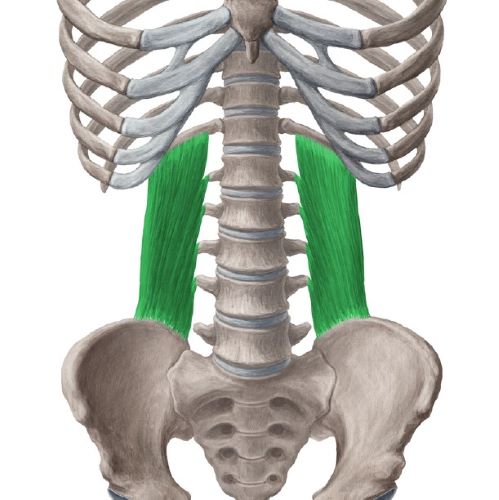
Quadratus lumborum muscles
Gluteus medius and hip adductors
The gluteus medius and hip adductors work in opposition to each other to stabilize ambulatory movement.
Located on the outer hip, gluteus medius helps stabilize the pelvis and maintain balance, particularly during single-leg movements like walking, running and accelerating through a turn. It acts to externally rotate and abduct the hip.
Form is critical in putting gluteus medius to use. The exercise involves abduction and external rotation of the leg. While standing and holding onto support, lift one leg out to the side and externally rotate the leg (turn out so the foot points away from the body). Make sure that the leg is pulled back, so it is in a plane behind the standing leg. Squeezing gluteus maximus will help, as it straightens the hip joint. Lift leg slightly in a pulsing manner, and make sure you do not lose your start position. Your leg will not move much, but if properly done, you will feel it on the side of the buttock behind the hip bone; 30 seconds to 1 minute per side should do it!
Although gluteus maximus is not considered a stabilizer muscle, it is essential to good running technique and often underused, which can lead to hamstring and calf strain. These are the large muscles of the buttocks. One of the best ways to access and exercise them is to lie down face up with knees bent, feet flat on the floor. Tuck your tailbone under and squeeze your buttocks to lift them slightly off the floor. Hold for 5-10 seconds, then lower but not all the way. Repeat up to 10 times. This is known as a glute bridge.
Hip adductors originate on the lower pelvis and attach to the inner femur, drawing the legs toward the center line of the body. They stabilize and support during walking, running and turning. (We have six hip adductors, but only adductor magnus is shown here.)
These muscles can be strengthened easily by either lying face up or standing upright with knees bent and squeezing a medium size ball between the thighs. Squeeze as hard as possible for 5-10 seconds, release slightly, then repeat 5-10 times.
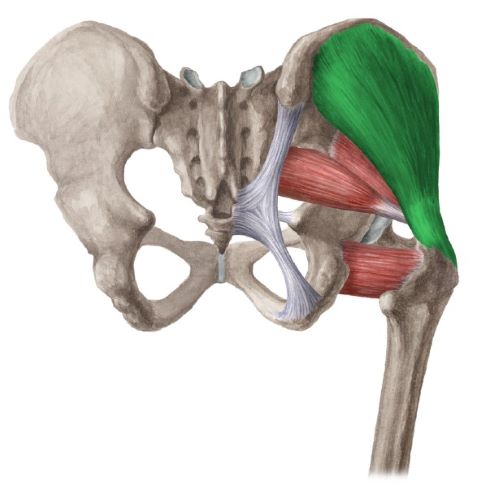
Gluteus medius muscle
Rotator cuff muscles
Rotator cuff muscles stabilize the shoulder joint, ensuring proper alignment and movement of the arm. Combined with good posture, shoulder and neck strain are minimized.
Rows and pushups are the most efficient ways to begin the process of strengthening the scapular stabilizers. You can perform rows with weights or bands. The important thing about rows is that they are generated by lifting your chest and squeezing your shoulder blades (scapulae) together. Start with arms extended forward, either with weights or one end of a band in each hand. Lift your chest, and as you pull your arms back, squeeze your shoulder blades together so the top of your upper arms moves back. Hold in the “back” position momentarily to feel the squeeze of the shoulder blades and the spinal muscles that lift your chest, then ease back to start and repeat. Go for 10-15 repetitions.
Pushups can be done with hands on a wall, horizontal surface such as a table or bench, or if proficient, the floor. Find a height that allows you to do 10-15 pushups to fatigue. Engage your deep abdominals and maintain a plank position through the entire movement, not letting your hips drop or elevate, but maintaining a straight line from head to heels. Stay on your toes the whole time.
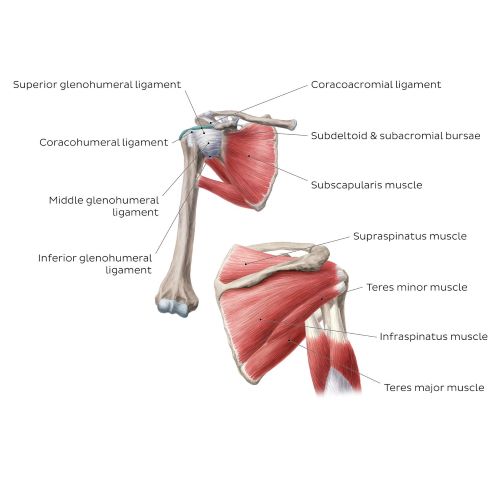
Rotator cuff - Posterior shoulder
Deep neck flexors
Deep neck flexors support the head and neck, opposing excess strain on the posterior neck and promoting proper alignment.
These muscles are best activated when participating in proper posture. If your head juts forward of your body so that your ear is ahead of your shoulder, this is a good starting exercise. Lying face up, press your chin into your neck and retract your head into the floor so the back of your neck moves toward the floor. Hold 5 seconds, release slightly, and repeat. Do this 10 times. You may feel a stretch in the back of your neck as you practice this.
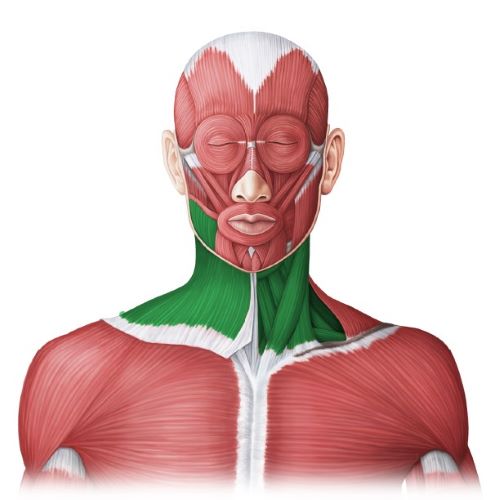
Anterior neck muscles
In conclusion...
Of course, there are many other exercises that can benefit handlers in their quest to get around a course easily and quickly. The exercises here focus on the primary muscles that will benefit you no matter your fitness level. If you try anything and it is painful or worrisome, STOP doing the exercise. Pain is not gain. Because of the limitations of this article for instructing physical education, please be sure to check out my YouTube channel.
Jenni Westerfeld has been a Certified Personal Trainer and Corrective Exercise Specialist in Austin, Texas, for 25 years. Her training emphasis is on developing a functional, fit and healthy body by focusing on good posture and core strength, improving balance, flexibility and stamina, along with sound nutrition and a positive approach to lifestyle. A former equestrian dressage trainer and competitor, she started dog agility about two years ago. For more information, email her at jenni.westerfeld@gmail.com. Anatomical illustrations credit: kenhub.com.