Eyes on the Prize
Team USA medalist doesn't let multiple sclerosis keep her from competing -- and succeeding.
Since being introduced to dog agility by her mother in 1992, Kate Moureaux of Simi Valley, California, has become a professional agility competitor and trainer, won 11 National Agility Championship titles and competed on 10 World Teams for the United States. With a keen understanding of dog behavior and training, she founded DrivenDogs Agility in 2004 to sha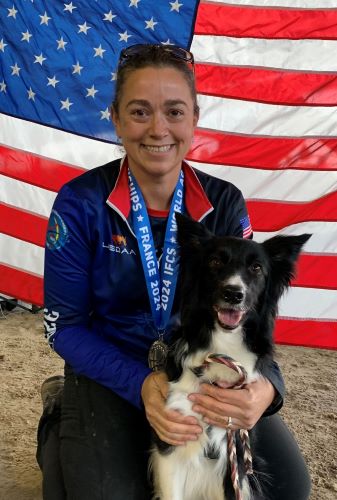 re her knowledge with fellow dog lovers and became a certified USDAA® judge in 2008 to continue giving back to the community.
Some recent highlights of Kate’s career include three podium finishes at the Purina® Pro Plan® Incredible Dog Challenge National Finals (2021-22), two National Championship titles at the Cynosport® Dog Agility World Games and U.S. Open in 2023, and a silver medal in the 2024 IFCS World Agility Championship’s Individual Standard division. She and her dogs have also earned rally, obedience and herding titles, including the 2017 Rally National Championship (Novice).
What makes all these achievements truly special is that they occurred after Kate was diagnosed with multiple sclerosis (MS), a chronic autoimmune disease that damages the protective covering of nerves and disrupts communication between the brain and body. Some of her initial symptoms in the fall of 2016 included brain fog, trouble with her balance and proprioception, and loss of motor function on the right side of her body. She used a cane for some time to help with a severe limp, and her right arm would (and still does) curl toward her side. She and her doctors reduced many of those symptoms with a quick, aggressive treatment of steroids, but she still must be mindful in some situations.
“I do still struggle with brain fog, balance issues and fatigue, which is exacerbated if I push myself too much or am not getting enough sleep,” Kate said. “When my body is done, it just feels like I hit a wall, and some of my initial symptoms will start to resurface. The medication I take to help control the MS has also made me immunosuppressed, and I have some additional complications due to its side effects.”
Along with taking medication, Kate tries to stay active and eat healthy to manage her symptoms. She hasn’t had to make significant changes to her agility training, but she is more aware of the temperature (heat exacerbates the disease) and her recovery time after events. She has also started renting golf carts at bigger events to conserve her energy for the actual competition, and she purchased a travel trailer in late 2020 for more control over her environment at out-of-town shows.
“My initial onset was a real whirlwind, but I don’t recall any specific behavioral changes from my dogs,” Kate said. “Thankfully, my girls are all pretty good with any curveballs thrown at them. I’ve also trained them to do some small, helpful tasks if I’m struggling with my symptoms.”
 Many of her top agility accomplishments were achieved with her 7-year-old homebred Border Collie, Excel Eye On The Prize (“Prize”), her first dog born since her diagnosis. “In addition to being my agility partner, Prize has been an amazing support and reminder to stay focused on the moment and my goals,” she said. “She helps me not to get bogged down by all the scary potentials of this disease. Some dogs come to you at important times in your life, and I’m so lucky that Prize is that dog for me.”
Despite having MS, Kate focuses on living in the moment and enjoying everything as much as possible. “When dealing with health issues, listen to your body,” she said. “I find it good to push myself, but I need to know my limits or make sure I have time to recover if I overdo things. And like Prize’s registered name, sometimes we just have to keep our eyes on the prize (and maybe be a little crazy) to make things happen.”