From Foster to Family: The Best Kind of Fail
Foster caregivers who made the leap to adoption
This article was originally published in the June 2025 OVERview digital magazine.
A “foster fail” is a term affectionately used when someone who intended to temporarily foster a dog ends up adopting them instead. While the goal of fostering is to help dogs transition to permanent homes, sometimes the bond between foster and pup becomes too strong to break. What starts as a short-term commitment can quickly turn into a lifelong connection, especially when the dog feels like the perfect fit. Though technically a “failure” in fostering terms, it’s really a heartwarming success — one where both dog and human find exactly what they didn’t know they were missing.
Dolly, the natural athlete
Dolly isn’t the only foster dog Loni Gaudet has fallen in love with and kept; in fact, Loni credits her first foster fail, Moki, for picking Dolly to be a part of their home forever. Although Loni had only done herding and rally with Moki, when Dolly came to her off the streets of La Junta, Colorado, at about a year old, Loni quickly realized that Dolly wanted to go down a different route in canine sports.
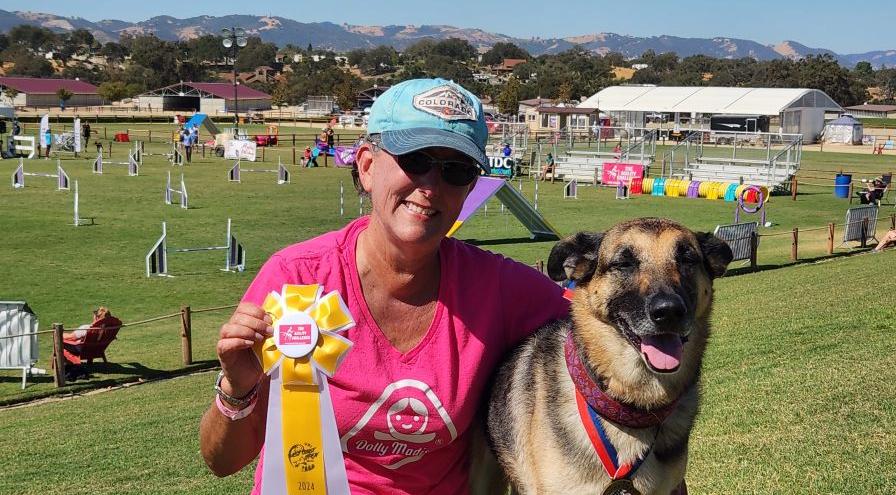 “I wasn’t interested in agility at the time because I thought it was too loud,” said Loni. “But it turned out that it was Dolly’s thing, and I loved the foundation training enough to ignore the noise.”
According to Loni, both of her foster dogs were a dream to train. “They were both naturally athletic and eager to play and train.” She found Dolly, in particular, to be a natural athlete. Agility has given Dolly a way to develop proprioception, fitness and mental focus, while also allowing the pair to develop a wonderful bond and confidence in each other. Even as Dolly ages and has to scale back in the amount of agility training she does, Loni still sees Dolly searching for that mental stimulation and connection that agility brings.
“I don’t know if it’s because new agility handlers lack expectations or because they just go with the flow, but I think she is exceptional,” said Loni. “Dolly loves to train, is very resilient and has an incredible heart as a competitor. Nothing shakes her, and she’s the steadiest, most consistent partner I could have wished for.”
For those who have the means and ability, Loni highly recommends going the route of fostering a dog. However, Loni pointed out that not all dogs adjust as quickly as Moki and Dolly did. Some fosters may need more time to get to know their new surroundings. Protecting your pack is something Loni feels is always top priority, and if a foster isn’t working out, finding that foster a better fitting home shouldn’t be seen as a failure.
To Loni, the time spent in the early stages of fostering to get to know Dolly, taking her to vet appointments and just allowing her to decompress was extremely beneficial for a future of competing together. As Dolly approaches 10 years old, the duo is still finding success in the show ring, even podiuming in Steeplechase at last year’s Cynosport®.
“Fostering is a great thing to do whether you are test driving for your next dog or just providing a dog a soft landing along its journey to its forever home,” said Loni. “We are at our personal capacity with three dogs now, but I would love to foster again in the future!”
Mirko’s zest for life
After just two months in Caroline Youngblood’s Bryan, Texas, home, Mirko went from a temporary rescue at 8 weeks to a permanent foster fail before he turned 5 months old. At the time, Caroline already had five dogs and wasn’t planning on opening her home to another. However, when a local rescue contacted Caroline to work with Mirko to teach him basic manners to make him more adoptable, the pair quickly formed an inseparable bond.
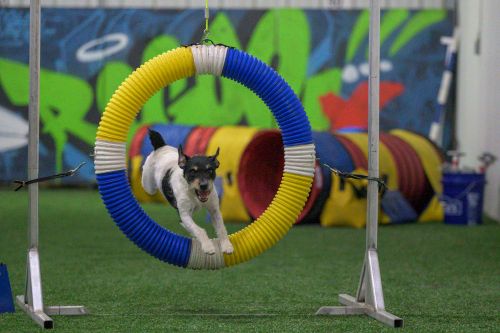 “I took him inside to a local agility trial, and to my surprise, he was super engaged and quite focused. He also loved meeting lots of new people,” said Caroline. “I started to work on agility foundation skills with him, and he was a very willing student. After some discussion with my husband, we decided to adopt him.”
Caroline points out that training a foster dog doesn’t come without its ups and downs, and she knew that terriers come with their own specific challenges. Despite still working through some focus and arousal issues, Caroline said she is loving the journey they’re on together.
“Mirko is super vocal and has lots of zest for life,” said Caroline. “The agility training has certainly brought us closer together, and I’m often surprised how deep our relationship is.”
Over the past 10 years, Caroline has taken in numerous puppies through Russell Rescue Inc., using her expertise as a professional dog trainer to give them the foundation they need to succeed in their forever homes. Currently, Caroline is taking a break from fostering puppies and focusing her attention on caring for her senior, special needs dogs.
“We have a soft spot for seniors that probably will not get adopted due to their age,” said Caroline. “Fostering has brought much joy to our lives over the years, knowing that those dogs will get another chance at experiencing a loving home and all the care they need.”
Tarzan’s new home
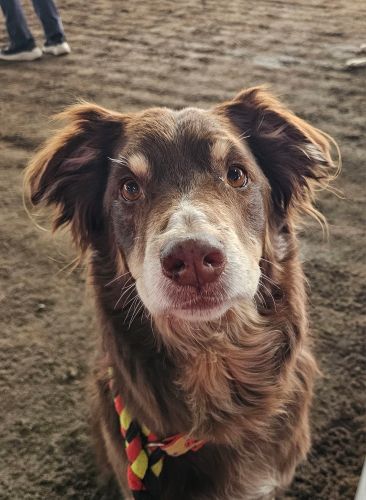 Over the past 40 years, Astrid Smith of Layton, Utah, has adopted 10 dogs from rescues, with four out of the 10 turning into foster fails.
Tarzan came into Astrid’s life in 2013, when she volunteered to foster his mother and assist in the birth of Tarzan and his six littermates. “His mom and dad were put in the shelter drop box. Australian Shepherd Rescue pulled his mom and found out she was pregnant. I volunteered to foster mom and whelp this litter of seven beautiful puppies,” she said.
“Tarzan has had a very successful agility career and is still very active in other dog sports,” said Astrid. “I love teaching all my dogs agility, scent work, barn hunt and tricks. It’s not difficult when I know what motivates them.”
Fostering is extremely important to Astrid, and to this day she continues to foster, currently housing an Australian Shepard that came to her from a rescue. However, Astrid also knows the importance of setting boundaries and exercising caution when taking in a new foster.
“It is important to me that the rescue trusts my professional opinion when placing my foster dog with an applicant,” said Astrid. “I am also very careful to only foster dogs that are not going to stress out my personal dogs.”