Snooker Revisited
Understanding the Game. Republished from a past issue of the USDAA Dog Agility Report™
The Game of Snooker
Snooker Agility, like Gamblers, is a strategic game in which competitors design their own plan to navigate the course and score as many points as possible, showcasing the effectiveness of their skills and strategy. Having sound performance skills and an understanding of a dog’s abilities are a prerequisite so that proper attention can be given on the strategic choices made while playing the game. Over the past several months, USDAA has studied the Rules of Play and will soon be publishing revised regulations to address inequities that have arisen in the scoring system for the class.
To provide background on the class prior to release of the new Rules of Play, the following article is being republished from a past edition of the USDAA Dog Agility Report™, which describes the game of Snooker after which the class was derived.
SNOOKER – A Competitive Game
Snooker Agility seems to be one of the most difficult classes to understand without first having tried it. The variety of options available seems endless, but the game really is quite simple. After all, what can be so difficult about a sequence of twelve obstacles! Understanding the original game of snooker itself can be helpful in playing Snooker agility.
Snooker is an English table game played on what we in the U.S. would call an over-sized pool table, with the exception that the pockets are narrower. There are fifteen red balls that are racked up on one end of the table (see image below), along with six other colored balls (yellow, green, brown, blue, pink and black) that are spotted on the table in what is called Snooker Position. 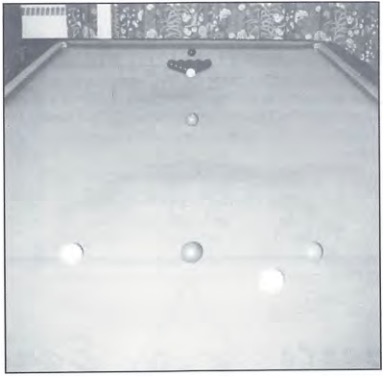
These balls carry values from 2 points to 7 points, respectively. The object of the game is to accumulate more points than your opponent by sinking the balls in the sequence defined by the rules of play (the “Snooker Sequence”).
The Snooker Sequence
The Snooker Sequence consists of two segments: the Opening Sequence and the Closing Sequence. The Opening Sequence is Red – Color – Red – Color – Red – Color, etc. until all fifteen red balls are sunk. The reference to Red means any red ball, and the reference to Color means any of the colored balls other than red.
If a Red is sunk by a player, he earns the right to attempt to sink a Color of his choice for additional points. The player' s choice of Color will be based on as assessment of risk of making the shot when considering points needed to try to beat his opponent. For example, he may try for the Black for seven points (the highest valued ball) resting on the table's edge or try for the Yellow (only two points) that is an easier shot resting near a pocket. He may instead try to sink Blue ball (worth five points) because he thinks he has a reasonable chance of sinking it, though the shot is more difficult than the Yellow because it provides a higher score that an opponent must overcome.
In performing the Opening Sequence, whichever ball he chooses, he gets only one attempt. When a Red is sunk, one point is earned, and the ball remains in the pocket. When the ensuing Color shot goes in the pocket, points are earned, and it is immediately placed on the table in its original Snooker Position for the next shot.
The player must then sink another Red before trying for another Color. If a player fails to sink a ball, play passes to the other player, who then takes their turn. They must sink a Red before trying for a Color. Should the second player miss a shot, play passes back to the other player. This pattern continues until all Reds (and the ensuing Color) have been cleared from the table. The Color following the final Red is placed for the Closing Sequence, marking the end of the Opening Sequence.

The Closing Sequence then begins where each colored ball must be sunk in ascending point-value order to clear the table and end the game. Any missed shots results in play being passed back and forth between players. When the Black is sunk and the table is clear, the player with the most points is the winner.
Since sinking the colored balls in the Closing Sequence yields a fixed point value (2 + 3 + 4 + 5 + 6 + 7 = 27), the strategy is in the Opening Sequence, where the player must attempt the highest possible points while performing the Reds and Colors. The strategy for Snooker is two-fold. First and foremost, don’t miss a shot, and second, choose a Color that has a chance to be pocketed to provide the optimal score (not always the maximum, since the Black is not always a feasible shot). One is said to have been Snookered if they are in a position to not be able to make the desired shot. So, the choice of which Red and Color is chosen must consider the shots to follow, so that the cue ball is in position to make the next shot.
Snooker Agility
In Snooker Agility, the obstacles take the place of the balls, the handlers are the players, and the dog is the cue ball.
Each obstacle is assigned a color, and the obstacles are positioned according to the judge s course plan, which may resemble the standard snooker pool configuration shown, or it may be modified to provide more strategic options, as if the balls have been scattered on the table after the "break ". To keep the round under 60 seconds, generally only three or four Reds are used, with displaceable hurdles used. This provides for a course of only 12 or 13 obstacles and keeps the game moving along quickly.
During a walk-through, each handler evaluates the obstacle placements for point values and a strategic path to earn optimal points. In planning his course, the handler must assess obstacle point potential versus risk and difficulty (i.e., the chance for faulting the obstacle and the time required to perform it) as well as handling and performance risks.
The competitors running early in the class generally must try to accumulate as many points as possible in order to place pressure on the competitor running later in the class. The dog/handler teams running later in the class have the burden of out-performing the dogs running earlier m the class. In the end, the team with the most points is the winner, and any tie is won by the competitor performing in the fastest time, or by run-off.
In the Dog Agility Masters® team tournament, each member of the team will have a spot in the line-up, ideally distributed throughout the running order. This more closely resembles play passing back and forth between players as in snooker, since the second (and third) team members have a chance to improve their team’s standing by changing their strategy as the class progresses.
Difficulty comes for most competitors in the Opening Sequence. If the planned course run is disrupted by an unexpected faulted red or the dog taking a Color other than the one intended, the competitor may have to adopt an alternative course of action to save the round (i.e., to adopt an alternative strategy by selecting a different Color for more points, which requires a change in their planned path). An experienced handler will explore alternative courses of action during the course walk-through to prepare for that situation.
In dog agility, the Red is considered sunk once it has been taken—faulted or performed successfully. If the Red is faulted, the opportunity for a Color is lost as if an opposing player has sunk the Red following the former player’s miss. So, another Red must be attempted to maintain the sequence. Points are earned for each successfully performed obstacle.
The only restriction in the Opening Sequence is that a Red must be performed successfully before a Color is taken, and a Color must be taken following a successful Red. One point is earned for successful performance of a Red, and the assigned point value of the Color is earned for its successful performance. If any faults occur, no points are awarded for the Red, or the Color.
Following the Opening Sequence, the handler moves directly to the Closing Sequence.
Each obstacle in the Closing Sequence is to be performed in sequence based on its color/ point designation - yellow (2), green (3), brown (4), blue (5), pink (6), and black (7).
If an obstacle is faulted, a Color is taken out of sequence, or course time expires, the round is over and points accumulated represent the final score.
Supplemental Note: The fault or wrong course penalties ending the Closing Sequence simulate Snooker as if the opposing player runs the table when the first player misses the shot. Upcoming rules take a different tact recognizing that the opposing player also misses a shot, passing the play back to the first player each time a fault occurs.