Stuart Mah Reflects on USDAA Over the Years
Hall of Fame Pioneer shares memories and insights.
This article was originally published in the April 2026 OVERview digital magazine.
Stuart Mah of Jacksonville, Florida, a leading innovator of canine agility in the U.S. since 1989, has excelled as a competitor and instructor, competing at the highest levels of the sport. He also served on advisory boards for both USDAA and AKC and was on the initial board of directors for USDAA, helping to define its competitive programs and rules. Visit his Hall of Fame page here. In honor of USDAA’s 40th anniversary, we asked Stuart to share his observations on the evolution of agility.
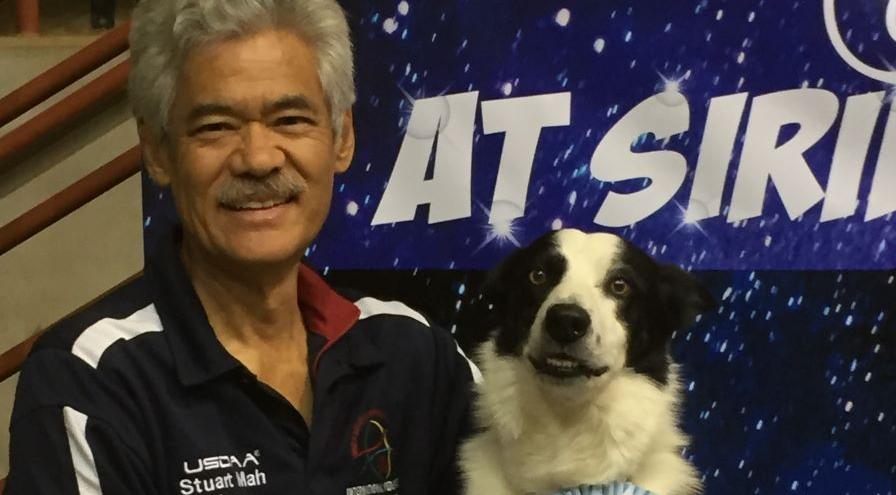
Stuart Mah and Ares (Diamond LAA)
Fond memories…It’s all about the people.
In the early days, everyone pretty much knew everyone else since the agility community was fairly small. You could go from one show to another and see a lot of the same people. Even as USDAA expanded, you could still go from one area to another (including cross country) and still find quite a few people that you knew. The atmosphere was competitive yet friendly, and just about everyone was more relaxed. You could feel less stress in the air at USDAA events versus other venues.
People were willing to help others out as well. I remember one show I went to that was being used as a point-gathering show for qualification for one of the overseas teams. I had just come off Masters Snooker and was the second-to-last dog in the whole class. My next class was essentially a Masters Challenge Jumpers that was used for points. The walk-through was supposed to start after Snooker was done, so I went to put my dog back up in the RV. I was coming back to the arena to walk the Jumpers class, but when I arrived, the class was already running.
Mary Ellen Barry was standing next to the ring and said they had already finished walk-throughs. (The walk-through had been permitted while the Snooker class was running.) As I had not walked it or seen the course map, she immediately started describing the course and places people were having trouble. I spent a minute looking at the course, ran back to the RV to get my dog, got him warmed up and into the ring. We ran clean and won. But without Mary Ellen’s help, that would never have happened.
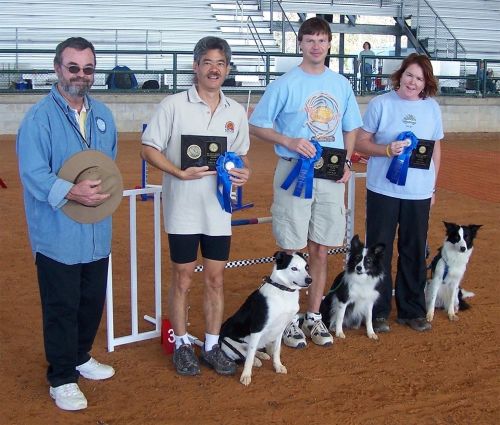
Florida show winners: L-R, Bud Houston (Judge), Stuart Mah, Terry Smorch, Mary Ellen Barry
Early Competition
One thing I remember about the early days is the fun you could have with the “odd” classes. At that time, the only “important” class was the Grand Prix of Dog Agility®. Titling didn’t exist until 1991, and the games classes didn’t become a more important part of titling until years later. The team tournaments were only held occasionally, mostly at a national agility event or somelarge regional event held in conjunction with a major horse event, such as seen at Fairhill, Maryland. There were no Steeplechase® and no BiathlonSM classes. To fill the time and give people more to do, we held the “odd fun” classes. One of them was Boxed Pairs.
Boxed Pairs
Boxed Pairs is just a regular pairs class, with one dog/handler team running the first half of the course while the second dog/handler runs the second half. The difference between Boxed Pairs and regular pairs is how the exchange is done and how it is judged. If the first handler makes it through the first half of the course clean, they exchange at the box, and the second team runs the second half to finish. Or at least that’s how it is supposed to go. However, if the first team has a fault, they must go directly to the box and make an exchange. The second team then becomes the “active” team and has to pick up where the first team faulted. This forced exchange happens each time there is a fault.
As an example, if the first dog misses a frame contact, the second team has to start at the frame. If they get through the first half, they make the exchange, and the first team now has to run the second half of the course. So even though a team would only have initially planned to run one half of the course, they had to walk both halves to be fully prepared.
The tricky part here is that since the second dog is now the active dog, the judge begins judging at the point of exchange. Even if the second team has to start the course at the A-frame, the dog is being judged as soon as it leaves the box. So, if on the way to the frame the dog takes an obstacle, it is considered off course. Now the second dog/handler team has to return to the box, and the first handler has to pick up where they left off.
This kind of exchange can go on for a little bit, which, in fact, happened to me. I ran first and got through the first half, then headed back to the box and made the exchange. My partner took off but faulted somewhere in the middle of the second half of the course. They headed back to make the exchange, and my dog immediately faulted the faulted obstacle. I went back to the box and made the exchange. Upon leaving the box, my teammate’s dog took an off course. Back to the exchange box, exchange, fault. This went on for quite some time. For some reason, neither of us could get back to the original faulted obstacle without messing up. One of us finally got to the second to the last obstacle where again, we faulted. By the time we finished the course, at least five minutes had gone by. People around the ring were in hysterics.
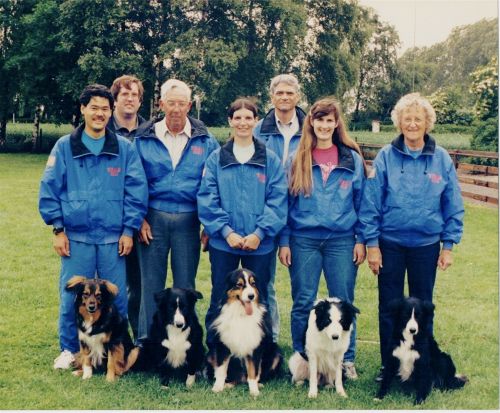
The first USA team to compete in Europe (World Dog Show, June 1991). L-R: Stuart Mah, Ken Tatsch, JC Thompson, Sharon Nelson, Dennis Harris (Pedigree® representative), Felicia Whalen and Hazel Thompson. They placed third that year. Stuart and his dog Shannon competed in Europe and won the Grand Prix of Dog Agility® as well as the Dog Agility Masters® team tournament.
Gamblers Stories
Long before Gamblers was part of titling, it was used as the warm-up class. (Before the warmup class was established, there was obstacle familiarization, where multiple dogs were on the course at once to practice the obstacles. You can imagine that didn’t last too long.) Since the guidelines about designing any of the games classes were pretty vague, a judge could add some variation to it, such as, if you could do all three contacts without fault, you got an extra 20-point bonus. Another was essentially a jump chute (i.e., sequence) consisting of three jumps with a very short space (like 15 feet) between each jump. If you did the chute successfully, you got 10 points (instead of just one point per hurdle).
The most unusual setup though was a set of two weave poles set in an “L” shape. The dog could enter from either end of the “L” to weave one set, and then immediately begin the other. Once entered, you got a point for every pole the dog did; however, if your dog missed a pole, you could not attempt the poles anymore. It may not sound hard to most people, but the second set was tucked right next to the first set, so the dog literally had to wrap the last pole to have any chance of hitting the entrance to the second set. Several dogs attempted it, and the record for that event was 48 poles, by completing it twice.
I remember in that class, my dog Recce tried to jump the dogwalk. The gamble started with a straight tunnel that was 10 feet on the other side of the dogwalk such that the dog had to run under the dogwalk to get to the tunnel (the handler line was the dogwalk). Since the dogs couldn’t readily see the tunnel on the other side, most didn’t do the gamble.
Look for more anniversary reflections from Stuart in next month’s USDAA OVERview.