Trailblazing Olympian Goes to the Dogs
Mary Mairs Chapot, champion equestrian and agility competitor
This article was originally published in the February 2026 OVERview digital magazine.
When Mary Mairs Chapot stepped to the line with Meagan, her wire-coated Jack Russell Terrier and first dog in agility, it wasn’t exactly Mary’s first rodeo. A trailblazing lifelong equestrian, she racked up various “firsts” throughout her career on horseback. In 1960, at age 16, she became the first rider from the West Coast to travel east and win the country’s two most prestigious equitation finals — the American Horse Show Association Medal and ASPCA Maclay — at the National Horse Show, held in New York City’s Madison Square Garden.
The following year, she became the youngest woman rider on a U.S. equestrian team. In 1963, she was the first woman to win a gold medal at the Pan American Games, winning both the Individual Gold as well as the Team Gold. The following year, Mary and Kathy Kusner were the first women to ride on a U.S. Olympic show jumping team at the 1964 Tokyo Games. Mary also competed in the Pan Am Games in 1967 as well as the 1968 Olympics.
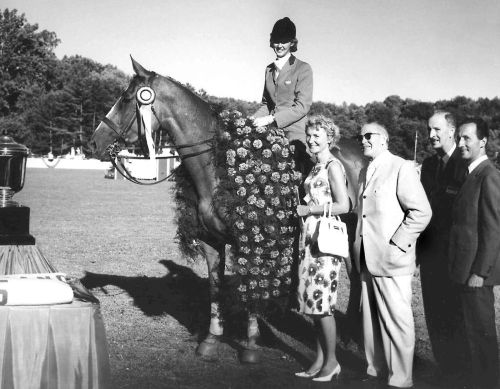
Mary Chapot aboard Tomboy winning the Cleveland Grand Prix in 1965 (Courtesy of The Cleveland Grand Prix:
An American Show Jumping First)
Gone to the Dogs
Mary wed her U.S. teammate Frank Chapot. She won 22 Nations Cup representing the U.S., and by 2016 she’d gone to the dogs.
As with many horse people, the Chapots usually had several Jack Russells cavorting around the barn. Sometime around 1990, as Mary recalls her introduction to agility, “the Jack Russell Terrier Club of America used to run little trials that included an agility competition. I saw one and thought I’d like to try it.”
So she stopped into her local bookstore and found a book about agility, “with diagrams of how to make jumps out of PVC,” she said. “I skipped all the steps you’re supposed to do at the beginning, but somehow Meagan and I managed to muddle through our first trial!”
Janet Selltzer, a local professional dog trainer, took Mary under her wing, telling her, “You look like you could do all right, but you could use a little help.” Under Janet’s tutelage, Mary and Meagan went on to earn three MACHs.
“I decided my second dog should be faster,” said Mary, “so I got one of the long-legged Jack Russells that are now known as Parson Russells. His name was Jamie, and I just ran him some.” Jamie had a bad habit of nipping at Mary from the dogwalk. “I liked tunnels, because then he couldn’t bite me,” said Mary. “Jamie never won any big titles, but he taught me what the world of agility is all about.”
Mary’s next dog came from Sue Sobel of Foxfield Terriers. “Susan’s dogs have the best dispositions — lovely temperaments,” said Mary. Over the years, Mary acquired three dogs from Sue. The first one, Lacey (Irish Lace) earned eight MACHs. “When I retired Lacey we left 76 QQs on the shelf. But then she got slower and slower.”
“Agility is a fun game,” said Mary. “I love the people and the camaraderie. Once in a while, I’d even skip a horse show to do agility — not often, but sometimes. We also did USDAA.”
Horse Training vs. Dog Training
Mary found certain commonalities between horse training versus dog training. “A lot of the rules of the game are basically the same — run fast, go clean — but you can’t touch the dog. That was something I really had to adjust to. The dogs love agility. They knew what was coming when they got their baths the day before a competition!”
As with many of her fellow handlers, Mary found weaves to be the most challenging to train. “I tried so hard to be accurate that I slowed my dogs down a little,” she said ruefully.
During her years in the sport, until vision problems forced her to retire from agility, Mary noted many changes. “When I started in agility,” she said, “the terrain was all grass, with a little uphill and downhill to it, so you never knew what that was going to do to the dog’s stride. We didn’t have indoor facilities like you do now. And nowadays, you really can’t just read a book about agility, then go out and do it!”
As for Mary’s friends in the equestrian world, “Horse people are very supportive,” she said, “but I don’t think they really understand what agility is or why people pursue it. It’s just fun — a fun pastime with your dog.”