Wellness Wednesday: Conditioning, Fitness and Strength Training for Our Dogs
Fundamentals for building strength, balance and more
Canine conditioning and fitness training has become very popular over the last few years. How can this training benefit our sport dogs as well as our retired/senior dogs and our puppies? A good conditioning program will help build strength, balance, flexibility, power and endurance in our dogs. Our competition dogs will have a different plan and exercises to meet their goals compared to our senior dogs and puppies.
There is so much more to a fitness plan than just getting our dogs to balance and do things on the really “cool” equipment. Like any new training program, they need to learn the fundamentals and gradually build to more complex and difficult exercises. We need to start with an assessment of our dog's posture. Are they balanced on the right and left? Do they sit nice and square or do they sit with their hind legs to the side? Do they lie down square, or always shift to one side? What about how they stand; is it even and square?
Most conditioning work is performed slowly and purposefully. This allows us to really assess our dog’s symmetry and balance. When our dogs are running at speed around the agility course, it is very difficult to really be able to see if they are using their body evenly. Performing proper conditioning work requires us, the handler, to really pay attention to the small details of our dog's posture. We need to teach them how to stand straight, with all legs evenly underneath, to sit even with both hind legs folded evenly and hind feet pointed straight forward. This attention to detail is what helps build the correct muscles for the best strength and power.
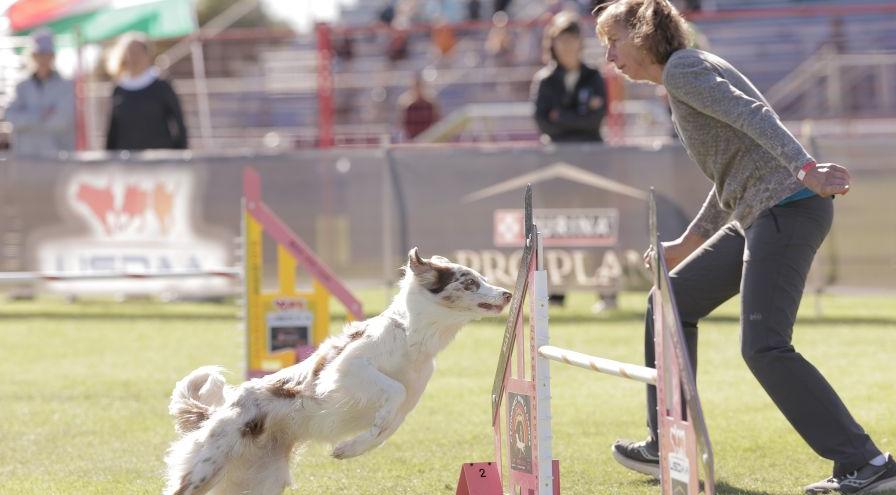
Libbi Peltz and Aria
It might be tempting to think we need to get our dogs on the fancy unstable (inflatable) equipment to get the best benefits, but in reality, the stable equipment provides some of the best workouts and benefits for our dogs. It really targets the major big working muscles. In addition, they need to be proficient at the exercises before adding instability to the program. Getting on unstable equipment too soon without a solid understanding and control of the exercises can potentially lead to injury.
Exercises can be designed to specifically target the dog's front end, core and hind end. We want to be sure we work the dog in all directions — front to back, sideways and turning exercises.
If you are new to this training to add to your dog's cross training fitness programs, then I would encourage you to find a Fitness/Conditioning Certified Coach/Trainer in your area and get some in-person help. In-person is really great for immediate feedback to help with your mechanics to teach your dog, as well as assess your dog's strengths and weaknesses. There are also many good online resources for your continued education.
Ideally, conditioning sessions should be done about three days a week and only be about 5 to 10 minutes long. Here are a few exercises to get you started, or to review if you have started incorporating conditioning into your dog's training.
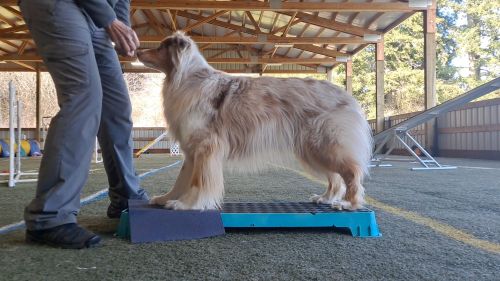
Square Balanced Stand
Don’t be fooled ... this seemingly simple exercise works the core as well as building endurance and strength holding a stand for a brief time. It is an isometric exercise.
Stand your dog on a low elevated platform, narrow enough to encourage his legs to be square underneath.
- Exercise 1: Have them hold it without moving any feet for 5-20 seconds; release and repeat.
- Exercise 2: Have them stand still, and walk around them in both directions. This really works the core and builds strength as they weight-shift without moving their feet to watch you walk around them.

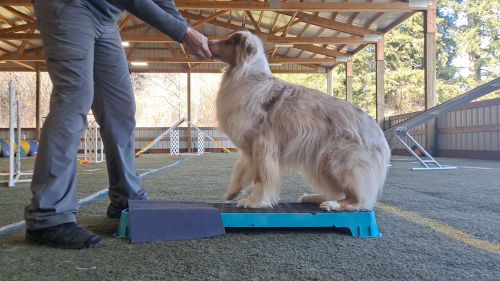
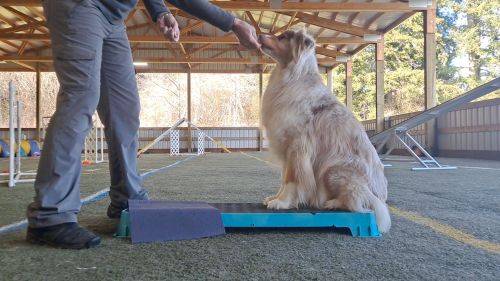
Rock Back Sit, Back to a Stand
This is great for building power and strength to the hind legs. Think of how your dog needs to push off the hind end to lift off for a jump.
Start with your dog on a raised platform, narrow enough to encourage their back feet to be straight when they sit.
- Exercise: Start with your dog in a square stand; then, using a cookie, ask them to push back to a sit. They should move slowly and evenly. The hind feet should not move; the front legs should walk back to the hind legs. After they sit, nice and square, ask them to come back forward to the stand. The hind feet should not move or shift for this exercise.
Front End Push-Up with a Side Step
This is great for strengthening the front end muscles as well as working the front adductors and abductors. Think of what your dog's front end does when they weave.
Start with your dog in a square stand on a low elevated platform, no higher than his wrists/carpus. The goal is to get them to step off with one front leg to the side of the platform, then back to center. This uses the adductors and abductors of the moving leg, and the "push-up" is done with the leg still on the platform. It will do the push-up when you return them to the platform. The hind feet should remain still.
- Exercise: Sit in front of your dog and lure them with some cookies to step the left front leg off the platform to the left side. You can place a target for them to step on if that helps. Lure them back to the center to the stand. Repeat to the right.
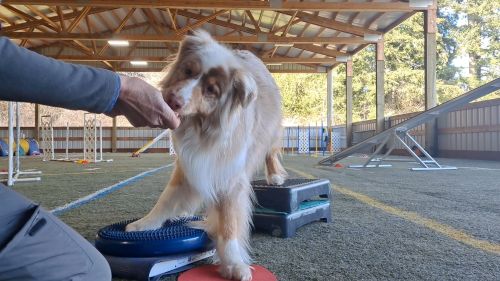
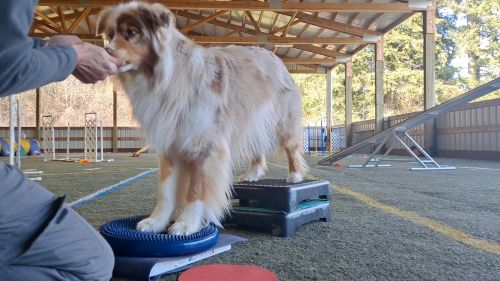
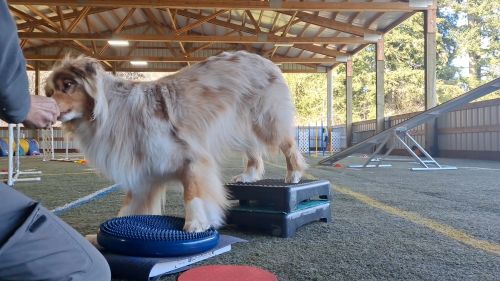
Have fun adding conditioning training to your dog's routines! They love all the attention and working for you.
About Libbi Peltz DVM, CSCC
Libbi started with agility about 2007 with her Australian Shepherd, Diva, and became completely hooked on the sport! She has continued to compete, and started teaching agility classes about 6 years ago. Currently, she has two competition dogs, both Australian Shepherds: Flute, 8, and Aria, 4. They recently competed successfully at Cynosport® World Games Presented by Purina® Pro Plan® in November 2024. Outside of agility, Libbi works as a small animal veterinarian in the Pacific Northwest. Over the last few years she started to focus on canine conditioning. She believes the benefits it offers to keep dogs fit and strong and to help prevent injuries is amazing. It has helped her retired sport dog, Tosca, who is 13, keep her strength and balance. And it helps keep dogs active and engaged with you when they can’t do all the fancy things anymore.