Handling Under Pressure
How to Manage Your Thoughts When You Step to the Line
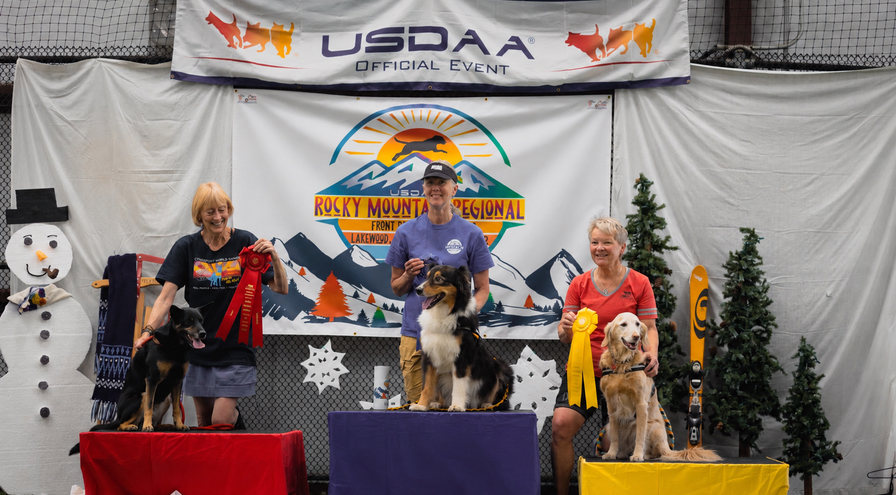
Something that seems to come up with teams is when we really want the Q for our ADCH/PDCH or a bye for Cynosport, and suddenly we do not know how to handle the pressure that is building in our chest or fogging up our brain.
This has come up many times across different areas of the country. Why do we, as handlers, put so much pressure on ourselves to win or perform? Is it because we believe everyone is watching us, or that if we do not hold a certain title, we are not good enough? That is simply not true. Most people in the sport of agility are so focused on their own dogs, their own runs, and their own routines that they do not even notice what is happening in your run.
With that being said, handling under pressure is often self-inflicted. The thoughts we create can either support us or work against us. The question becomes how to manage those thoughts in a way that allows us to step to the line and execute with clarity and confidence.
Goals
When entering any competition, whether local, regional, or national, it is practical to set goals. Goals allow you to stay in the right headspace and avoid overextending yourself by focusing only on outcomes.
Practicing writing down even the smallest goals, such as arriving ten minutes before briefing, can immediately put you in a better mindset to start the day. Small, achievable goals build momentum and set the tone for success.
Goals also help keep you grounded. Instead of chasing results, you begin to focus on execution and connection with your dog. They shift your focus to what you have been working on in training and allow you to trust the training. Instead of chasing results, you begin to focus on execution and connection with your dog.
Focusing on execution rather than outcome changes everything. When your goal is to run the plan you trained instead of chasing a Q and playing it safe, you stay present. You handle what is in front of you rather than worrying about what might happen if everything goes perfectly. Ironically, that is often when the Qs happen the most.
Goals also give you something to return to if things do not go as planned. If you have a mistake early in the run, you can reset and ask yourself if you are still meeting your goal of connection, clear communication, or supporting your dog. This allows you to finish the run strong instead of letting one mistake define the entire day or weekend.
Breathwork
When pressure builds, your body reacts quickly. You may feel your chest tighten, your breathing becomes shallow, and your heart rate increases. None of these responses support smooth and effective handling.
Breathwork is one of the simplest and most powerful tools you can use to reset.
Before stepping to the line, take three to five intentional breaths. Inhale through your nose for four seconds, hold for two to three seconds, and exhale slowly through your mouth for six to eight seconds.
This process helps calm your nervous system, brings your focus back to the present moment, and releases physical tension you may not even realize you are holding.
You can also pair your breathing with a cue word such as smooth or together. Over time, this becomes a ritual that signals to your body that it is time to settle in and focus.
Your dog will feel this shift as well. A calmer handler creates a more confident and connected dog.
Visualization
If you have ever replayed a mistake repeatedly in your mind, you already understand how powerful your thoughts can be. Visualization is simply choosing to use that power intentionally.
Before your run, walk the course with purpose. Then step away and mentally run it. Picture your dog taking the correct lines. Feel your movement, your timing, and your cues.
Make the experience as detailed as possible. Think about where you will decelerate, where you need to support, and where connection matters most.
If something feels unclear during visualization, that is valuable information. It shows you where you may need to simplify your plan or choose a handling option you trust more under pressure.
Visualization builds familiarity, and familiarity builds confidence.
Trust Your Training
Pressure on a course often appears when we begin to doubt what we already know. This leads to second-guessing, overhandling, and micromanaging, which can create confusion for our dogs and ruins our timing that each one of us has worked so hard to achieve.
Your dog does not need a perfect handler. Your dog needs a consistent and predictable one.
Trusting your training means committing to the plan you walked, giving the cues you have practiced, and allowing your dog to do their job. Consistency creates clarity, and clarity builds confidence for both handler and dog.
Reframing the Run
At the end of the day, every run provides information.
Instead of asking whether you qualified, consider asking whether you supported your dog where they needed it, maintained connection, and followed through on your plan.
When you shift your focus in this way, pressure begins to lose its influence. Success is no longer defined by a single outcome, but by a series of controllable actions.
Handling under pressure is not about eliminating nerves. It is about learning how to work with them.
A certain level of pressure means you care, and that is not a bad thing. The goal is to channel that energy into intention, clarity, and connection.
When you step to the line, it is not about the Q, the title, or who may be watching.
It is about having fun with your dog.