Course Walk Prep: A Beginner's Guide
Getting the Most Out of Your Walk-Through
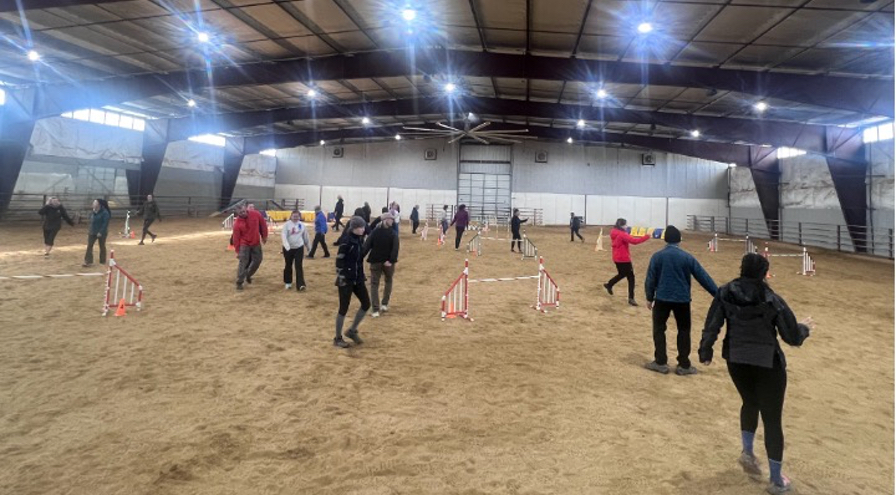
Whether you're stepping onto the agility field for the first or fiftieth time, the course walk is one of the most valuable tools you have as a handler, and one of the most underutilized by newcomers. Learning how to use that time well can be the difference between a smooth, confident run and a chaotic scramble trying to remember where you're supposed to be.
Preparing to Walk Your Course
Depending on the trial, some course maps are emailed or posted the evening before a trial. This allows you to have a head start on course routines, that competitors even a decade ago didn't have. How you use that map is up to you, but if you're a beginner, using it is almost always a good idea.
Some handlers obsess over it, worrying about every tight turn, off-course trap, and handling decision. Others glance at it once and wait until the course is set on the ground to form their plan. Neither approach is wrong, but for newer handlers, spending some intentional time with the map prior to your walk through can significantly reduce anxiety the day of the trial.
A Great Beginner Habit: Draw On Your Map
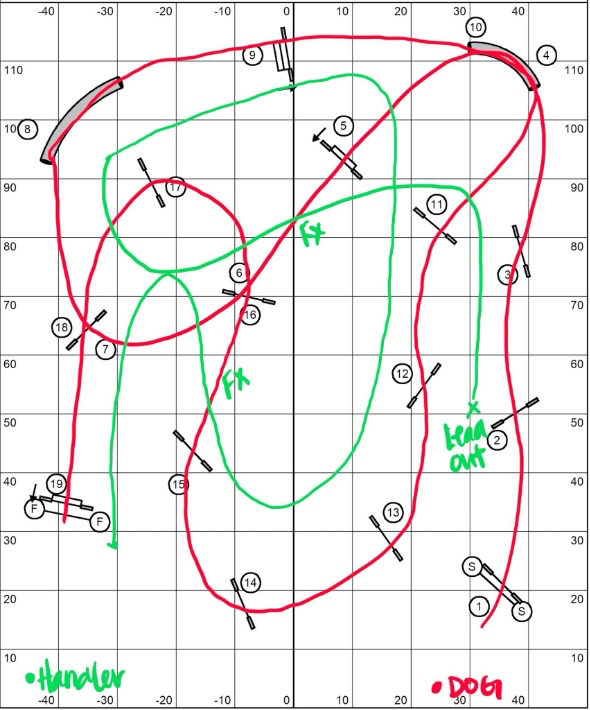
Sketch in the path you think your dog will take. Mark the spots where you'll need to cross from one side to the other. Circle anything that looks tricky or confusing. Color-coding can help too. Use one color for your dog's line and another for your own path. This kind of visual preparation helps the course feel familiar before you ever set foot on it, so when you're walking it in person, you're confirming a plan rather than building one from scratch under pressure.
What Is a Course Walk and Why Does It Matter?
The course walk is a dedicated window of time, usually 8 to 10 minutes, given to handlers before their run while the dogs are not on the field. You walk the course on foot, following the numbered obstacle sequence, and use that time to plan exactly how you and your dog will navigate it together.
For beginners, this can feel overwhelming. There's often a crowd of people moving in different directions, pointing at obstacles and talking in shorthand that sounds like another language. That's okay. Focus on your own plan. Here's how to approach it.
Three Ways to Walk a Course
1. Walk the Dog's Path First
This is one of the most recommended methods for beginners because it forces you to think like your dog.
Walk each obstacle in order, but instead of thinking about where you will be, focus entirely on where your dog will be. Where will they take off for a jump? Where will they land? Which direction will they naturally want to go after coming out of a tunnel or weave pole entry?
This matters because dogs don't read maps. They respond to momentum, your body position, and the path of least resistance in front of them. If there's an off-course obstacle that lines up perfectly with your dog's natural trajectory after jump 4, you need to know that before the run, not during it.
While walking the dog's path, keep an eye out for:
Off-course traps. Obstacles that aren't next in the numbered sequence but are positioned in a tempting line for the dog.
Tight turns. Places where the dog will need to collect and shorten their stride rather than drive forward at full speed.
Safety hazards. Holes in the ground, sprinkler heads, uneven terrain, or anything that could cause injury. If you find something concerning, you have every right to approach the judge and ask if it can be adjusted.
2. Walk Your Own Handler Path
Once you have a sense of where your dog will be going, walk the course again, this time focusing on where you need to be.
This is where newer handlers often get tripped up. It's easy to follow your dog mentally but forget that you, as a two-legged creature with a very different speed and turning radius, need to be in a very specific spot to cue each obstacle correctly. Being even a step or two out of position can send your dog off course or into an obstacle at the wrong angle.
Ask yourself: Where do I need to be to support my dog's entry to this obstacle? Am I going to be ahead of my dog here, or will they be ahead of me? Is there a place where I need to sprint to get into position in time?
If you find a section where you genuinely don't know how you'll get there in time, that's your signal to either plan a different handling strategy or make a note to work on your footwork and timing in practice.
3. Walk Your Crossing Patterns
Crossing patterns are the moments when you switch from one side of your dog to the other. Front crosses, rear crosses, and blind crosses are all examples. As a beginner, you may only be working with one or two of these, and that's perfectly fine.
During your walk, identify every place where you plan to cross. Walk through the physical motion of each one. Is there enough space? Will you be in your dog's way? Will the cross happen before or after the obstacle?
Many beginners skip this step and pay for it in the ring. Crosses that look easy on paper can feel rushed or awkward when you're actually moving. Walking through them lets your body remember what to do even when your brain goes blank mid-run, which is completely normal and happens to nearly everyone.
The Seasoned Handler Walk-Through: What Beginners Can Learn From It
You'll notice experienced competitors who barely glance at a map and just walk. They follow the numbers, pause briefly at a tricky section, and seem to have the whole course figured out in four minutes.
This comes from years of pattern recognition. Experienced handlers have walked hundreds of courses and can quickly match what they see to familiar sequences and handling solutions they've used before.
As a beginner, you might not have that library yet, and that's completely okay. Don't try to rush past this stage. The handlers who skip map prep and walk it cold aren't doing it because it's the objectively the best method. They're doing it because experience has made it efficient for them. Your most efficient method right now probably involves more preparation, and there is nothing wrong with that.
Know Your Dog
No matter which walk-through method you choose, one of the most important factors in your planning is knowing your individual dog's tendencies.
Does your dog have a wide turning radius and tend to overshoot tight turns? Plan for it. Does your dog love tunnels so much they'll dart into any dark opening they see? Identify every tunnel on course, not just the ones in sequence. Is your dog faster or slower than average? That changes your timing and number of obstacles for the Games classes. Does your dog hold a start-line stay reliably, or do they tend to self-release early?
Knowing these things allows you to build a plan that plays to your dog's strengths and manages their weak spots, rather than a generic plan that might work for any dog but not specifically yours.
Visualizing Your Lines
One technique used by experienced handlers that's absolutely worth introducing to beginners is visualizing the line you want your dog to travel, not just the obstacles themselves.
Your dog doesn't teleport from jump to jump. They travel a continuous line through the course, and the shape of that line affects their speed, their angle of approach to each obstacle, and how cleanly they can flow from one to the next.
When you look at your map, try to see the path rather than just the numbered dots. Where is the dog coming from, and where do they need to land to set up the next obstacle correctly? Minimizing unnecessary direction changes and wide looping paths can shave real seconds off a run and make the whole thing feel smoother for both of you.
Draw these lines on your map if it helps. Then, when you're on the ground, check whether the actual spacing matches what you imagined. The map and the ground sometimes tell slightly different stories. A pair of jumps that looked close together on paper might have more distance between them than expected, which changes how you'll handle the turn.
Walk-Through Checkliost for Beginners
If you're not sure where to start, here's a straightforward sequence to work from:
- Study the map the night before. Sketch your dog's path and your own. Circle anything tricky.
- Walk the dog's path first. Follow the sequence and think about your dog's natural line and momentum.
- Look for off-course traps and safety hazards. Note anything to ask the judge about.
- Walk your own path. Figure out where you need to be at each moment.
- Walk your crossing points. Physically rehearse any crosses you've planned.
- Do a full mental run-through to make sure the whole plan connects from start to finish.
- Have a recovery plan. If your dog takes an off-course obstacle, know how you'll regroup and get back on track.
Final Thought
The course walk is your time. Use all of it. Don't feel pressured by handlers who finish in two minutes they've probably been doing this for years. Your preparation is what will carry you confidently into the ring, and every minute you invest in the walk-through is a minute of clarity you'll have when it counts.
Over time, you'll develop your own rhythm and method. Until then, take the map, take your time, and trust the process.