Wellness Wednesday: Hydrotherapy for Dogs
Relieve stiff joints, improve mobility - and more.
Courtesy of YuMOVE
Although dogs have been launching themselves with abandon into lakes, ponds and muddy puddles for millennia, canine hydrotherapy is a fairly recent development.
A drop of hydrotherapy history
 Hydrotherapy was first promoted as a complementary therapy by Vincent Priessnitz, a farmer in Austrian Silesia in the 19th century. Priessnitz noticed that animals would instinctively immerse an injured limb into water every day until it was healed.
He started by trying this “water cure” technique on animals on his farm, then progressed to offering healing baths to human patients. By 1839, he had become so successful that he attracted 1,500 patients that year, including an impressive number of counts, countesses and other sundry monarchy.
From the 19th century onwards, perhaps inspired by Priessnitz’s experiments, hydrotherapy was used to rehabilitate racehorses and greyhounds. Today, it’s increasingly popular with all kinds of dogs.
What is canine hydrotherapy?
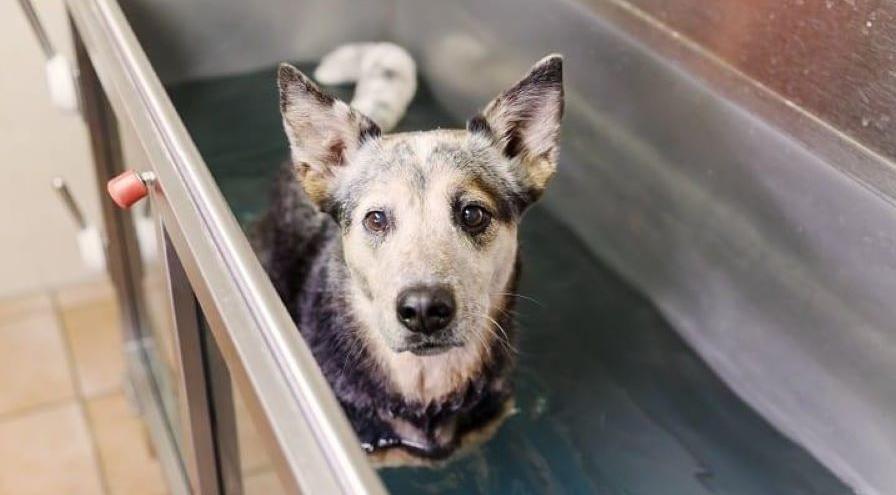
Under the guidance of a trained canine hydrotherapist, your dog swims or walks in warm water to help improve their fitness and function. Sessions usually take place either in a swimming pool or in a special tank (not unlike a giant fish tank) that contains a custom-made treadmill.
Good for stiff joints
Canine hydrotherapy is used for a variety of reasons, such as soothing stiff joints, improving mobility and cardiovascular
fitness, and helping your dog to maintain a healthy weight.
“The benefits of canine hydrotherapy depend very much on how the therapy is carried out,” said Adam Gibbins, chair of the National Association of Registered Canine Hydrotherapists (NARCH). “For some dogs, simply floating or swimming gently in water can relieve stiff joints. For others, more vigorous exercise is used to increase the use of limbs, increase muscle bulk and tone, and strengthen the support for joints.”
He added, “Water can also be used as a means of supporting dogs in a non-weight bearing or partially weight bearing environment to allow movements that would not be possible on land, perhaps because of weakness or injury. This is particularly useful for dogs that have spinal problems.”
The science behind it
Canine hydrotherapy works due to the properties of water, specifically:
- Buoyancy: water reduces the pressure on your dog’s joints, bones and muscles, allowing your dog to exercise more easily than they could on land.
- Viscosity: water is resistant to movement, so while your dog benefits from the buoyancy of water, this resistance also helps them to strengthen their muscles and improve their fitness.
- Hydrostatic pressure: the pressure of water against your dog’s body supports their joints and muscles, helps increase their range of movement and can improve circulation.
Typically, canine hydrotherapy takes place in warm water that’s between 82-89 degrees (F), which is the optimum temperature to help soothe stiff joints and encourage relaxation.
What happens in a hydrotherapy session?
“A typical maintenance hydrotherapy session starts with an update from the owners about how the dog has been and any activity that they’ve been undertaking,” said Gibbins. “The therapist will give your dog a warm shower and a massage to prepare the muscles.
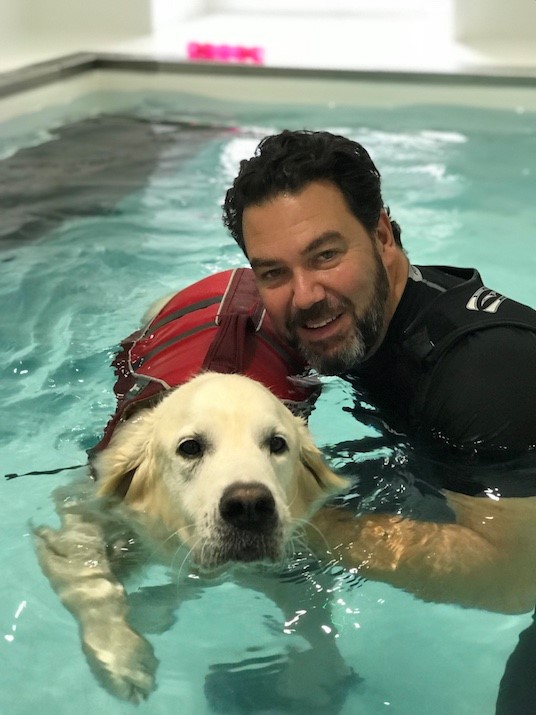 “In the pool, each session is tailored to meet the dog’s specific needs and abilities. It’s highly likely you’ll see controlled swims with the dog working in different directions, with physical input from the therapist to support and improve the dog’s range of motion.
“Throughout the session, the hydrotherapist makes observations and adjustments to how your dog is moving in order to improve their condition. Afterwards, your dog is showered once again to remove pool water from their coats. They are then towel dried, which has a massaging effect, which dogs adore.”
Suitable for (almost) every dog
He added that hydrotherapy is appropriate for all dogs, cats and small animals. However, he admitted, “Some dogs may be truly hydrophobic — scared of water — and in that case we would never proceed. Lots of dogs are uncomfortable with water, and it’s the role of the hydrotherapist to work with the dog and build their confidence.”
Canine hydrotherapy is not recommended for dogs with ear infections or skin conditions. In addition, the Canine Hydrotherapy Association recommends paying particular care to breeds that may find it more difficult to breathe comfortably in water under aerobic conditions.
Gibbins became a canine hydrotherapist over 10 years ago, when he made the decision to make a career change. He was able to combine his passion for animals with a full-time career in hydrotherapy and opened his own center with pool, treadmill, grooming and dog day care facilities based in London.