Wellness Wednesday: Know Your Dog's TEMP
Tail, Eyes/Ears, Mouth, and Posture reveal how a dog is feeling.
Originally published on Susan Garrett's Dog Training blog. Used here with permission.
Can you tell when your dog is anxious, and do you know when to remove your dog from a situation he is unequipped to handle? Do you know when your dog is confident and happy? Are you able to tell if your dog is engaged and happy when you are training (playing) together?
Dogs can’t talk to us, but they can communicate. Knowing what a dog is telling you is vital. Dogs have many signs to show what they are feeling.
T.E.M.P. is an acronym I believe I heard first from the late Dr. Sophia Yin. It stands for "Tail, Ears, Mouth, Posture." I think of the “E” to be Ears / Eyes, but TEEMP is not as neat an acronym as T.E.M.P.
T for Tail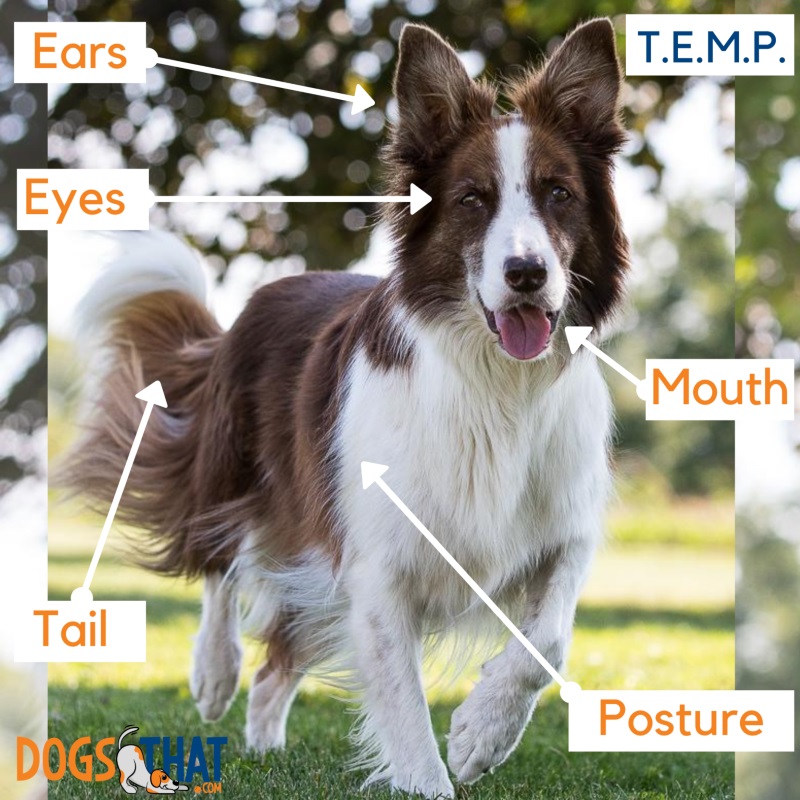
The tail is fairly obvious. Many people will say, "Oh, the tail’s wagging, happy dog.” Not necessarily. You’ve got to look at how the dog’s tail is wagging. Some dogs will wag their tail, and it creates an entire body wag, or it goes like a helicopter in a circular motion. That is a super happy dog. A lot of dogs will show different levels of happiness through a wagging tail.
Some dogs may tuck their tail and hold it up along their belly. You could say, "Maybe they’re cold," but a lot of times that is a sign of anxiety, stress, or a lack of comfort with the situation. Or, a tail could be held very stiffly above the dog’s back, and that could be the dog getting a little bit more territorial. A tail that’s held low between the hocks and is wagging kind of frantically is not necessarily a happy tail. The low wag could be a nervous tail and could lead to problems if you don’t interpret that correctly.
A lazy wag back and forth with other good signs is generally a pretty good indication that the dog is confident and happy with the situation.
E for Eyes, Ears
Eyes
If a dog’s eyes are full, bright, and alert, that’s a good sign. If you can see the whites of the eyes at the bottom, that’s not a good sign. Look at pupils; are they dilated, narrow, very, very small or very, very big? Depending on the light, eyes may dilate, but a narrowing of the eyes is a dog being more intent. Are the eyes darting side to side? Is the dog looking for an escape? Or is the dog staring? Staring is often a sign that a dog is intent on a target. Or perhaps the dog could be looking at something they are nervous about. Sometimes you see the eyes are almost closed to a slit. That happens a lot when dogs are being submissive, and the submissive dog is a dog who could be worried.
A dog with eyes that are moving naturally (like a person who is taking everything in) is a relaxed dog. A dog whose eyes are fixated is a dog who has intent on possibly pouncing and playing, or possibly attacking. A dog with darting eyes might be a dog who is not comfortable with the situation.
Ears
Obviously dogs have different earsets. Some dogs have a different set of each ear. Dogs like Labradors have floppy ears; my border collies have perky ears; and Tater-Salad has his own Tater ears. No matter what earset a dog has, you can see alertness with the ears "held high." The muscles in the dog’s skull allow dogs to rotate ears in different positions. If one ear is up and one back, the dog is listening to something in behind or trying to "take in" something behind. If the ears are up high on the head, the dog is confident or may be focused on something.
Ears brought together and pinned to the back of the head is often a sign that the dog is worried or fearful. If the ears are turned to the side in what is often called "rose budding" (not to be mistaken for a rose ear set), and turned in a little bit, with the dog showing little slits of their eyes, that is a submissive posture. If the dog’s ears are flat and plastered to the back of their head, that’s not a comfortable or confident dog. You need to take in all of these things together with other elements of T.E.M.P. when reading a dog.
M for Mouth
Sounds
We’ll look at sounds first. Pay attention to the way a dog is vocalizing. Is there growling? Now, growling doesn’t mean a dog is aggressive; a lot of dogs will growl in play. So, don’t be concerned if they start growling when you’re playing with your dog. My dogs growl when they’re happily engaging with me.
However, growling with some of the other signs — like seeing the whites of the eyes, or staring, or pinned ears — are not a combination that means a dog is in a good place. That is a dog that is showing you discomfort. You need to listen to the growl!
It is IMPORTANT to note that growling may be absent because a lot of dogs are disciplined for growling — something you should never, ever do! When a dog is repeatedly disciplined for growling, the dog will lose its voice, and you don’t ever want that to happen. A dog growling is saying, "I’m not comfortable with the situation. Please take me out of it." This is vital information for your dog to tell you!
When you remove the growl from a dog, all that dog has left is a bite. The growl is an excellent indicator for you. When you hear it, you want to make a plan to help condition the dog so they are more comfortable, but in the moment when you hear a growl, get your dog out of the situation.
Is the dog whining? Whining could mean that a dog is stressed or anxious. Whining could mean an overly excited dog as well. Is the dog barking? Barking could be happy. Barking could be alerting. If it’s a puppy barking, it could be that they’re just using their voice and that they’re happy. It’s important to look at all the elements of T.E.M.P. brought together when evaluating what a dog is telling you.
Physical Signs
Let’s consider physical signs involving a dog’s mouth. Is the dog showing teeth? If a dog is showing you a slit of their eyes, rose-budded ears, and their teeth, they’re being submissive. Some breeds of dogs will naturally do that when a stranger is approaching. And remember, it’s not good to approach any dog you don’t know without asking their owner first. A lot of submissive dogs are super happy to see people. Still, maybe not all people, and perhaps the dog is a little worried about children in particular. You have to ask the questions to find out.
Look at what the lips are doi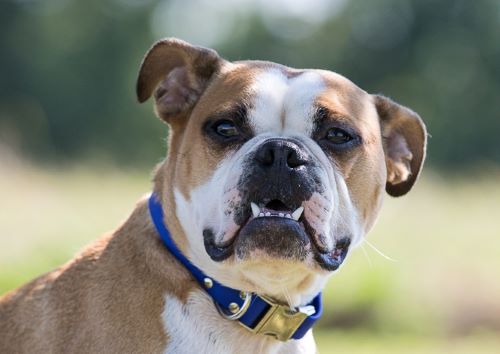 ng. Are the lips relaxed and loose, or are they pursed? If they’re held back and pursed, the dog may be nervous. Many people think that the dogs who bite are the ones who are growling. Dogs who are nervous are as likely and maybe even more likely to bite. Bad signs are a dog who is lip licking, lip lifting, showing you their teeth, along with growling, pinning their ears, fixating their eyes. If a dog is nervous and can’t get out of a situation, their only defense is to nip. A nervous dog pulling back and holding their lips in a tight mouth is a dog who is showing you great discomfort.
Lip licking could be a calming signal that the dog is trying to give another dog, and it may be combined with a shake off. These are signs that dogs give other dogs to try and defuse the situation: "Please, can we all be friends here?" Lip licking could be a sign that the dog is nervous. If a dog is licking their lip, averting their eyes, pinning their ears and tucking the tail, that dog is nervous, so give the dog space.
P for Posture
A dog who is relaxed will have low whole-body wag. Their tails wag and their bodies wag, and their ears are up and confident. You can see that the body wag is initiated from the tail.
A dog who is stiff with head up and fixed, and maybe has the hair up on the back of the neck right around their shoulders and at the base of their tail, is a dog who has been been triggered. They may be excited, they may be alarmed, they may be trying to make themselves big to protect themselves, but the dog is alert to something.
A dog who is crouching and low with their tail down could be a little worried about something. Certain breeds like Whippets, Italian Greyhounds, Greyhounds, naturally carry their tails low. Even some of my border collies might have their tails low between their legs, but that doesn’t necessarily mean that they’re nervous. You need to take all things into consideration.
A submissive dog might crawl and even turn the body sideways with a little frantic body wag. That is a dog who is not confident and might be slightly nervous, but is showing you submission and saying, "I’m not 100% sure about this situation but I really, really would like to experiment with it." A dog may just flatten themselves to the ground if they’re not confident or if they are nervous.
Reading a Dog’s T.E.M.P.
You need to see the big picture. Dogs who are mentally sound, which is 99% of the dogs out there, are going to give you these signals in a predictable way. If for any reason you think your dog might fall outside of that 99% go straight to a veterinary behaviorist.
If a dog is growling but has a body wag to the side, is averting their eyes to the side, and shows rose-budded ears and wagging their tail low, you are NOT going to rush in and pat that dog. But those signs do not necessarily mean the dog is going to lunge and attack you. A dog who is sore may give you a growl because they want to be left alone. You need to take in all of the information the dog is giving you. If you think your dog is sore, or has changes in his normal T.E.M.P., visit a vet.
Dogs can’t talk to us, but they can communicate. Dogs communicate with their body and sounds, and that allows you to know what is going on. The worst thing that you can do is not believe what the dog is communicating. Our number one goal is to help our dog be confident.

Save this chart to share with everyone who needs to know a dog’s T.E.M.P.
Your Role to Help Dogs
Never approach a dog without asking their owner first. Teach your children to never approach a dog without asking their owner first. Even if you have permission, look at the dog’s T.E.M.P. and make good decisions for you or your child and the dog.
Some people think that having people pat nervous dogs will help the dog, and that is something we call flooding in science. But flooding can often backfire. If you own a dog who is showing signs of not being confident or comfortable, a better thing to do is to keep that dog a distance away from their stressor where you can reinforce your dog yourself. Believe what your dog is communicating. Your dog is asking for your help, and as their owner, your number one job in life is to help your dog become more confident.
Never, ever discipline a dog who’s growling. The dog is communicating something very clear to you. As their owner, you need to get them out of that situation. Take note, go to a trained veterinary behaviorist and ask for help if you don’t know the next steps.
Supervise and Know Your Dog’s T.E.M.P.
Regardless of how "trustworthy" you believe your dog is, never leave any dog unsupervised near small children.
Ownership of a dog means that the dog trusts us to be their best advocate. This mea ns recognizing your dog’s signs of stress and responding appropriately. Never "force" a dog to accept something when he is giving you clear warning signs that he is not comfortable. Remove your dog from the situation and work with him at an appropriate distance from the distraction.
Learn to take a dog’s T.E.M.P. as the signs are the only way dogs can communicate their acceptance of any situation. As a parent, take the time to teach your children how to read these signs as well.
Respect What Your Dog Is Communicating
Recognize that any dog, when in "fear mode," is a creature of fight or flight. Escape will be their first choice. When escaping is not possible, a dog’s "fight" mode may kick in and can escalate from a low growl to a bite very rapidly. Never discipline your dog for growling as it is his only way to communicate his discomfort should you miss his previous T.E.M.P. signals.
Avoid creating anxiety by not allowing anyone to hug, push, poke, jump on, corner, or quickly grab at your dog. As humans, we should always allow a dog the choice to interact with us, rather than forcing ourselves on him. It is a matter of socially appropriate behavior on our part.
Once we are accepted by the dog, long strokes of the body or scratches of the neck and behind the ears are often the best way to show the dog affection. When a dog retreats away, respect their decision and allow them to choose to come back if and when they feel comfortable doing so. Understand that any dog can move from comfortable to fearful very quickly. A great way to get a dog to be more comfortable is to change their state through play.
Resources
I’ve covered T.E.M.P. before in many ways, and you can check out some of the key resources here on my blog and podcast.
 Susan Garrett’s interest in animal behaviour started at the University of Guelph where she earned a Bachelor of Science majoring in Animal Science. Since then she has developed into a pre-eminent canine sports instructor and competitor. Susan is one of the most successful agility competitors of the last two decades. She has won multiple Gold Medals at National or World Championship events with every dog she has ever owned over the past 30 years.
A natural teacher and an entertaining speaker, Susan is a leading educator of dog trainers. Her understanding of how to apply learning principles to practical and competitive dog training has made her a much sought-after speaker throughout North America and as far away as Europe, Japan, Australia and New Zealand. The Dog Writers Association of America named Susan’s book “Shaping Success” the 2005 "Dog Training and Behaviour Book of the Year."
Read more about Susan and her training philosophy.