Training Tuesday: Cross-Training with Rally and Agility
Discover how both sports can benefit handlers and dogs.
What is your background in rally?
I am a long-time competitor and fully certified (all levels) rally judge for USDAA’s World Cynosport® Rally Limited (WCRL). I became a trial chairperson in addition to a judge because I enjoy playing with my dogs and wanted to bring that joy to others.
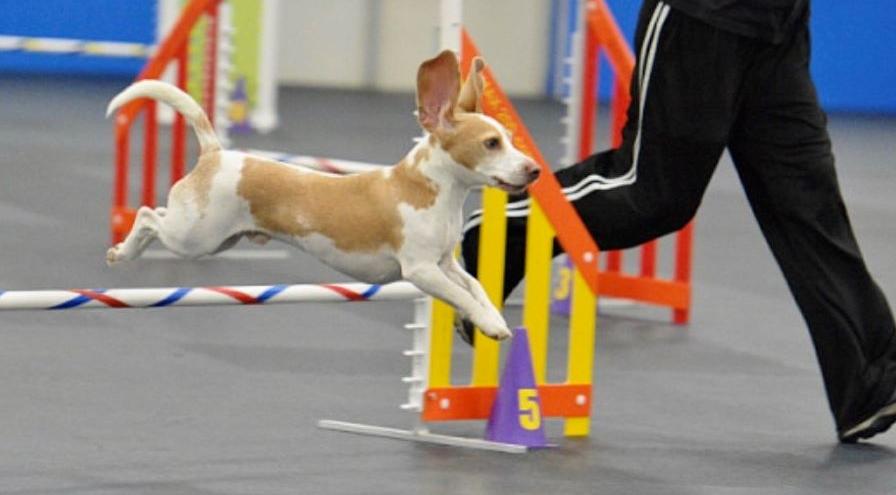
I began training and competing in Rally Obedience in 2010 with my beagle, Jellybean, and my Labrador retriever, Casey. My journey truly began when puppy Jellybean came into our home in 2003 and inspired me to learn how she saw the world. We were so happy together that I wanted to do more than walks and playing in the yard. Being a school librarian, I know education is the road to being successful. I decided I needed to learn more, so I went back to school to become a pet dog trainer. That’s where I learned about agility and rally. By 2006, I was beginning my own pet dog training career and began to learn about dog sports. We spent some time training and learning, and I began to compete in agility in 2009 and in rally in 2010. I currently compete in rally and agility with my four dogs — two beagles and two border collies.
Why did you combine rally and agility in your training and competing?
Jellybean and Casey began in agility and then started rally. I found that this was best for these two dogs I had at the time. I have raised and competed with seven of my dogs (plus a few foster dogs!); some of them benefited from competing in rally first to gain connection, value communication from the handler or simply gain ring confidence, while others benefited from competing in agility first.
It is interesting that 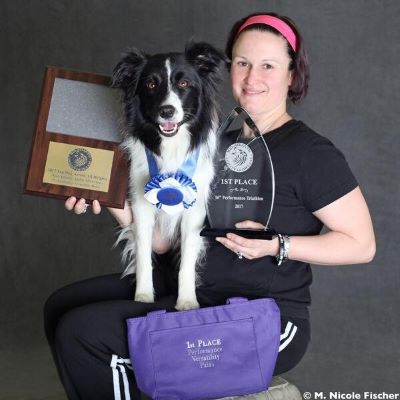 for some dogs the agility equipment was more helpful than rally to build a working relationship, while other dogs needed to get into the ring without that equipment to create a working team. Perhaps the equipment provides a visual cue for some that instills confidence, whereas other dogs are over-excited by the equipment. I’m sure there are many reasons, but this could be one explanation! In any case, I really needed to listen to each of my dogs and examine our training along the way to make the best choices for us.
Many people start in rally and then transfer over to agility. In working with multiple breeds, I find that the two sports support each other, and the progression is made most successful by being able to understand the dog’s needs and determine which sport is best to begin working in the ring environment.
How do you think the two sports complement each other? Can dogs or handlers benefit by being involved in both?
Rally Obedience training/competing builds a strong handler focus from the very beginning. This helps to create that working relationship that we can apply to life in general with our dogs as well as other sports.
Agility works to balance handler focus and obstacle focus from the very beginning. That helps dogs understand that working farther away is a good thing! Rally Obedience asks for distance skills as well, but not until at least level 2 when teams no longer have their leash.
Teams that have done agility will typically have an easier time with these levels because they have a foundation in working away. However, teams that begin in Rally Obedience and then transfer to agility also have many foundation skills as well, such as a solid stay, usually in all positions (sit, down, stand), and this will give them lots of opt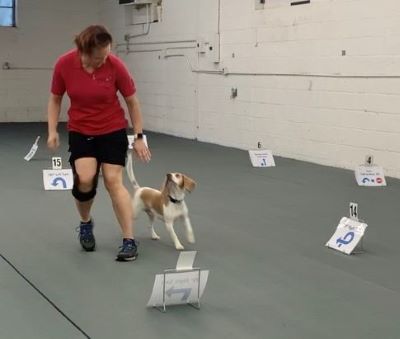 ions with their start-line stays!
Both sports work hard to build body awareness in the dogs. Heeling, finishes, back-up are all parts of Rally Obedience that need good body awareness, just as jumping, turning and performing contacts or weaves in agility require good body awareness.
Both sports require and therefore constantly challenge the communication, bond and teamwork. Dogs are not a verbal species, so we humans need to work harder to communicate with our dogs using words. From the dog’s perspective, body cues are clearer and more meaningful in both sports, which makes them both valuable in creating depth in a team.
Both sports are filled with people and dogs having FUN together because it strengthens our bond and our skills while guiding us to new challenges.
For those involved only in agility, or only in rally, why should they consider getting involved in the other sport?
Cross-training, both mental and physical! By definition, cross-training means: “the action or practice of training or being trained in more than one role or skill OR the action or practice of engaging in two or more sports or types of exercise in order to improve fitness or performance in one's main sport.”
One reason handlers choose multiple sports is to challenge themselves in different ways. For example, retrieving an object and returning it to the handler is a skill we judge in rally, but we also use it in playing agility when we use toys. Both sports teach dogs to carry an object in their mouth. It is a way to provide activities that are different so that they are more versatile as individuals and as a team. There are many skills that apply to both sports, and participating in both creates a different challenge for the same skill, just as there are various ways to execute a jump for the dog and various ways to ask the dog to go over the jump.
This versatility has another benefit. If a team can no longer compete in one sport (even if only temporarily), they still have a way to play together and challenge themselves mentally and physically in another. Once you have a working competition relationship with your dog, they need stimulation, even as they get older, develop a handicap, or their sport is no longer available to them for various reasons, etc.
Agility moves at a much faster pace than rally because the dog (and sometimes the handler) is running! This can be either exciting or overwhelming for both dogs and handlers. Conversely, working at a slower pace is more of a challenge for some dogs (and handlers!). Balance is the key, so having the skills to work as a team in both sports is a wonderful goal!
Each handler needs to honestly consider their dogs' needs and how they enjoy playing together, as well as re-evaluate this as they grow and change as a team.
 Jodi Kellar-Jackson, the owner of Kellars Canine Academy in Saddle Brook, N.J., extensively studied educational and behavioral theories on her way to earning two master’s degrees. She also graduated from Animal Behavior College, becoming a certified dog trainer and mentor for future ABC trainers. In addition, she serves the canine community as a certified judge for USDAA’s World Cynosport® Rally Limited (WCRL); a certified evaluator for the AKC Canine Good Citizen, AKC STAR Puppy Programs, and Pet Partner Therapy Team Program; a certified instructor for Do More with Your Dog and One Mind Dogs; and a UKI judge. Jodi makes training fun and challenging for all dogs. She plays at local and national competitions in multiple venues with her two beagles (Maggie and OBX) and two border collies (Sundae and StellaDora).