Training Tuesday: Tommy's Terrible Teeter
Tips for tackling your teeter tribulations.
Originally published on Megan Foster's Synergy Dog Sports blog. Used here with permission.
I’m going to tell you about Tommy. A very special JRT that came into my life around 2008. He belonged to Cherie Whittenberg, and I was lucky enough to be his agility teammate from 2008 to 2013. We went to five USDAA National events and racked up a whole lot of loot from those events.
But this story is about Tommy’s Terrible Teeter. And guys, I mean it was terrible. I don’t have footage of the very, very beginning, but here are some clips of what it looked like after quite a bit of training and “he’s always perfect at home” woes.
His terrible teeter was the last barrier standing firmly between our goals: High titles in USDAA requires standard Qs. Dreams of Grand Prix Finals require you to enter the GP at the event, and entering requires a couple of GP Qs, which requires an acceptable teeter performance.
Around this time, the “spider dog” handstand trick was becoming really popular to teach dogs. That trick got me thinking about how the teeter performance is really a rear foot behavior. Tommy really liked to go forward, collection wasn’t his best skill, and he was a bulky little terrier – some might even call him front heavy.
So, I went about teaching him this handstand trick. That went pretty well, actually. It was cute.
Was his teeter fixed? Not yet.
How could I convince this dog to keep his rear feet in contact with the board as it moves? He could keep contact with the wall, but of course walls don’t move. Or do they?
I progressed Tommy’s understanding of “spider” to doors. I’d open the door half an inch, cue “spider,” and he would then plant his front feet, swing his rear feet up and then make contact with the door, which then moved, and he moved with it. The criteria of “feet on wall” transferred to “even if the wall moves.” I watched this dog learn how to stay in contact with a moving board, and it was magic.
And that was that. I remember transferring his trick to the actual teeter, but not for long. I transferred the behavior “spider” to the end of the board, and within a few weeks, he was back on the full height teeter, now cued “spider,” and he never (and I mean never) flew off of or came off early again.
This training discovery of mine was nearly 10 years ago, and while my training habits have improved, this theory of backwards motion to make contact with the teeter has not changed. Instead of handstands, though, I only teach a few steps of backing up. I emphasize the rear legs moving first, and making contact with the target.
After the dog understands backing up, I teach the target position (4on is my preferred teeter end behavior) only on boards that move, and never on stationary boards.
I teach the teeter first of any contact obstacle. I have found that if the dog learns and trusts the equipment that will move first, they have less confusion later on with the dogwalk, than if taught the other way around.
Because my preference is for first using a wobbly prop and then using an adjustable teeter, we are able to layer in challenges like handling, sequencing, and proofing from a very early stage in your dog’s training, making the transition to competition much easier in the long run!
About Megan Foster
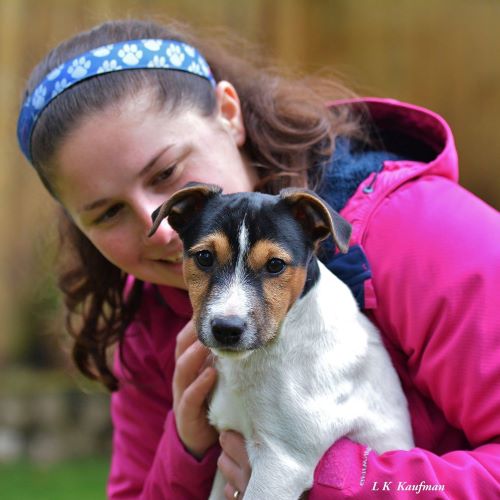 Megan Foster has been involved in the dog sport world nearly her entire life. With over 20 years’ experience, she has competed with a variety of dogs, including an American Eskimo and West Highland White Terrier, Shelties, border collies, and Parson Russell Terriers, and has worked with an even larger variety of breeds. Her accomplishments include many ADCh (USDAA Agility Dog Champion) titles, MACh (AKC Master Agility Champion) titles, Regional and National Championships, and representing the U.S. on the European Open in 2015. Megan was also a USDAA judge for over 10 years, providing valuable insight into course design, course analysis, and handling styles throughout the United States. Megan has been teaching agility full-time, in person and online, for six years, through her training school, Synergy Dog Sports. Megan became a OneMind Dogs Assistant Coach in 2016 and finished her Coach Certification in 2018. She believes in developing a system of communication based on the dog’s perspective and what dogs naturally understand and then individualizing that system for the humans that train and run them. Megan currently has three dogs of her own: Smack (border collie), Shock (border collie), and Shrek (Parson Russell Terrier); she lives with her partner, Graham, and his dogs, Skittles (Sheltie) and Skrik (border collie) in Stanwood, Wash. For more information, visit www.synergydogsports.com.