Training Tuesday: Toning Up On Cue Clarity
Review your cues to ensure they are distinct and clear for your dog.
This article is shared with permission from Susan Garrett's Dog Training Blog.
Late last year I ran a "clarity check" for Momentum and me as an agility team. You can read how I did this clarity check on my post “Does your dog have a CUE… or NO Clue?“ One of the things I reviewed was the verbal cues I use and the tone of the cues.
There are many scientific papers referencing what dogs hear as cues. One paper that I found a few years ago made the conclusion that dogs actually respond better to tones than they do to words. You might say that I leave no tone unturned in my research. As the sport of agility grows and evolves, we owe it to our dogs to grow and evolve as trainers and handlers, and as educators for our students.
Paying attention to the tone of your cues is not just for agility. It can be for family pets or any dog sport. Are the cues you use distinct enough to give your dog clarity? Do those cues have value and a good association for your dog?
I write down all the verbal cues I use for my dogs, and before I introduce a new cue, I check the list and evaluate the tone of the cue and where I am using it for my dog. This is a simple exercise that anyone can do. A cue we would all want to be distinct for our dogs is our recall cue, so that could go on your list. Include all the cues you know that you give to your dog.
Hearing the Sirens
We humans respond to tones too. Think of driving and hearing a siren. It’s very distinct. You don’t have to think about it. When you hear that siren, you start looking to pull over as you know there is an emergency vehicle coming through. The sound of a siren is unmistakeable. It doesn’t blend in with the “blah blah, blah, blah” of everyday life.
We have all sorts of things in our lives that have distinct tones to alert us (the ring tone on our p hones, the beeps from social media, the gadgets we have in our home). When you hear these sounds you know immediately what each sound means. And that’s what effective tones do for our dogs.
If you are doing dog sports, it is critical to review your cues from time to time and before you introduce a new one. Pay close attention to how you deliver the cue. (Visit the website for a video clip of me running through some of my agility cues so you can listen to the tone and delivery.)
Here’s how to do a cue tone evaluation for agility. You can do the same no matter what sport you do and for your everyday life cues.
- Write down all your verbal cues you presently use in agility. Include a brief description of the cue and the tone.
- Using your video camera or a voice recorder, record the way you say your cues. Many mobile devices have memo recorders.
- Play the recording back and note the clarity of these tones.
- If you have training or trial footage, review your footage to hear the tone of your cues. In this footage are your cues clear, and are they the same as you noted on the evaluation sheet?
- Next, review your recorded verbal cues. Can you hear a difference in your tone when using different verbal cues? If you can’t hear a difference, consider your dog will not be able to.
Your tone evaluation can help you become a student of your own cues. Each cue you have should be a very distinctive prompt for your dog’s agility behaviors. Are the cues clear to you?
If you are interested in the paper I referenced, click here for “Domestic Dogs Use Contextual Information and Tone of Voice when following a Human Pointing Gesture.”
About Susan Garrett
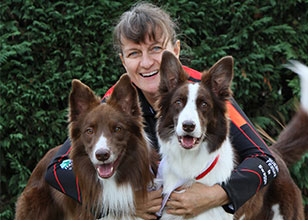 Susan Garrett’s interest in animal behavior started at the University of Guelph where she earned a Bachelor of Science in Animal Science. Since then she has developed into a pre-eminent canine sports instructor and competitor. Susan is one of the most successful agility competitors of the last two decades. She has won multiple Gold Medals at National and World Championship events with every dog she has ever owned over the past 30 years.
A natural teacher and an entertaining speaker, Susan is a leading educator of dog trainers. Her understanding of how to apply learning principles to practical and competitive dog training has made her a much sought-after speaker throughout North America and as far away as Europe, Japan, Australia and New Zealand. The Dog Writers Association of America named Susan’s book “Shaping Success” the 2005 "Dog Training and Behaviour Book of the Year."
Read more about Susan and her training philosophy.